Knowledge is protection when the IRS is involved. I'm Darrin Mish, a tax attorney in Tampa with 32 years of experience representing taxpayers nationwide. Here's what I want you to understand.
I'm Darrin Mish. Tampa tax attorney, 32 years in, more than $100 million in IRS debt resolved. That's my resolution practice. What follows is the other side of the desk – the planning moves that keep you from ever needing it.
Most business owners think about their 401(k) once a year when they set their deferral percentage. They're leaving money on the table. The 401k tax deferred structure is one of the clearest tax wins Congress ever handed you, but it works best when you treat it as a planning tool, not just a savings account. You shift income from high-tax years to low-tax years, control your marginal rate, and compound wealth on dollars the IRS hasn't touched yet.
The mechanics are straightforward. The strategy behind them is not.
How 401k Tax Deferred Contributions Actually Work
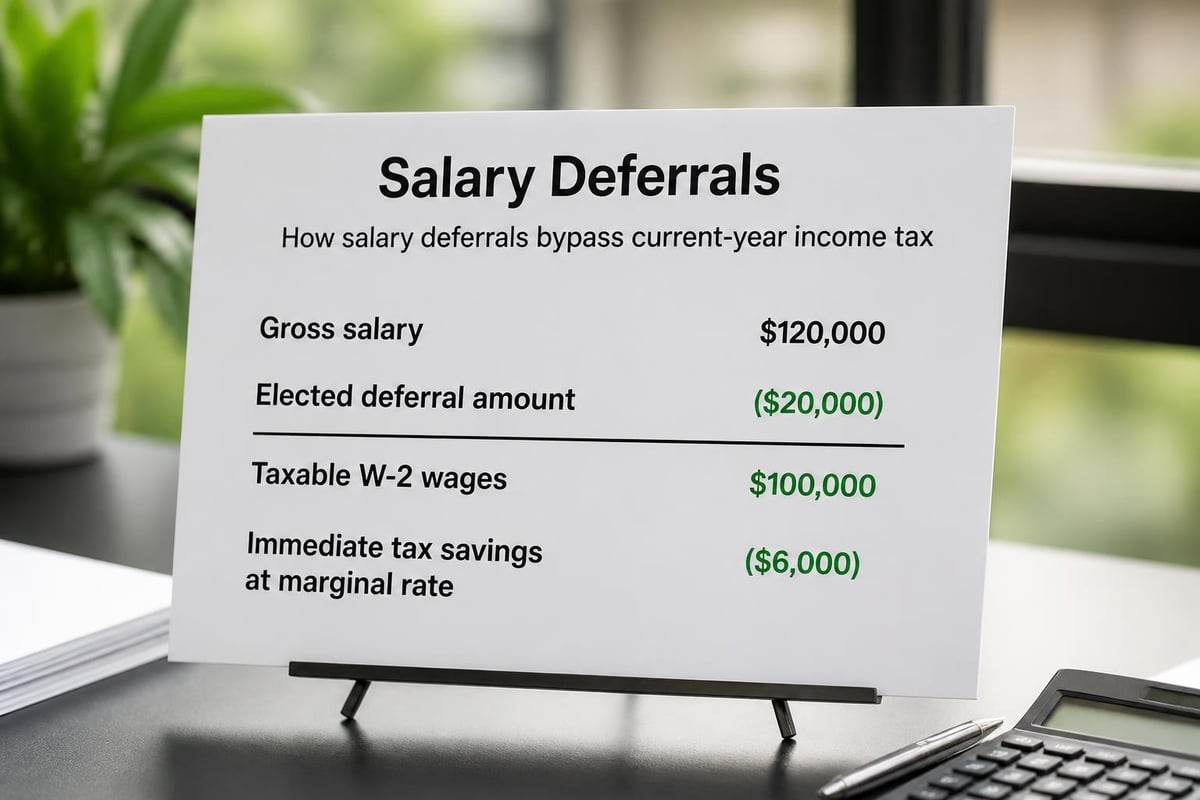
You elect to defer part of your salary into the plan. That amount never appears on your W-2 as taxable wages. Your employer reports it separately on your W-2 in box 12 with code D, but it's excluded from box 1 (wages subject to federal income tax). You save at your marginal rate today.
Let's say you're in the 32% bracket and you defer $23,000 in 2026. You just saved $7,360 in federal income tax this year. That money stays in the account, invested, and grows without annual tax on dividends, interest, or capital gains. No 1099s. No quarterly estimated payments on growth.
The trade-off is back-end taxation. When you take distributions in retirement, every dollar comes out as ordinary income at whatever your rate is then. No capital-gains treatment. No step-up at death for your heirs. Ordinary income, period.
Who Should Max Out Deferrals
High earners in peak income years. If you're in the 35% or 37% bracket now and expect to be in the 24% or lower bracket in retirement, the math is obvious. Defer today, withdraw later at a lower rate, pocket the spread.
Business owners navigating income spikes. Sold a division? Big contract year? Unusual bonus? That's the year to max your elective deferrals and shift income out of the current year. You can defer up to $23,000 in 2026 ($30,500 if you're 50 or older).
Anyone with an employer match. Free money. If your company matches 50% of the first 6% you defer, you're getting an instant 50% return before any investment gain. Even if you're in a low bracket, take the match.
| Income Level | Marginal Rate | Deferral | Tax Saved | Net Cost |
|---|---|---|---|---|
| $100,000 | 24% | $23,000 | $5,520 | $17,480 |
| $200,000 | 32% | $23,000 | $7,360 | $15,640 |
| $600,000 | 37% | $23,000 | $8,510 | $14,490 |
Your actual out-of-pocket cost to save $23,000 is less than $23,000 because you're saving the tax you would have paid.
Contribution Limits and Catch-Up Rules for 2026
The IRS sets annual limits on how much you can defer. For 2026, the employee elective deferral limit is $23,000. If you're age 50 or older by December 31, you can add a $7,500 catch-up contribution, bringing your total to $30,500.
SECURE 2.0 added a twist. Starting in 2025, participants aged 60, 61, 62, or 63 at year-end can make enhanced catch-up contributions. The limit for those ages is the greater of $10,000 or 150% of the regular catch-up amount (indexed for inflation). In 2026, that's roughly $11,250 for those in that age band.
These are elective deferrals. Total contributions (your deferrals plus employer match plus any profit-sharing) can go much higher. The overall annual additions limit for 2026 is $69,000 ($76,500 with catch-up). Business owners with solo 401(k)s or small plans can layer in employer contributions to hit those bigger numbers.
Highly Compensated Employees and Testing Limits
If you own the business or earn over $155,000 in 2026, you're a highly compensated employee (HCE). Your plan has to pass nondiscrimination testing (ADP/ACP tests) each year. If rank-and-file employees don't defer much, the IRS limits how much you can defer to keep the plan from favoring owners and execs.
Plans fail testing all the time. When they do, the company either refunds excess deferrals to HCEs (taxable in the year refunded) or makes additional contributions to non-HCEs to bring the averages into line. Safe-harbor 401(k) designs bypass testing by requiring the employer to make minimum contributions to all eligible employees. Trade-off: guaranteed cost, no testing headaches.
You need to know your plan's design before you defer the max. A failed test in March 2027 can create a surprise tax bill for 2026 income you thought was deferred.
Tax-Deferred Growth: The Compounding Advantage
The real power of a 401k tax deferred account isn't the upfront deduction. It's decades of growth with no tax drag. Every dividend reinvested, every bond coupon, every realized gain stays in the account compounding. You're earning returns on money that would have gone to the IRS.
Compare two scenarios. You have $10,000 to invest. In a taxable brokerage account, you pay tax on dividends and gains each year. In a 401(k), nothing is taxed until withdrawal. Assume 7% annual returns and a 24% tax rate.
- Taxable account: After 30 years, you have roughly $57,000 (growth taxed annually).
- 401(k) account: After 30 years, you have roughly $76,000 (no tax during accumulation).
At withdrawal, you'll pay tax on the 401(k) balance. But you've had 30 years of compounding on the IRS's share. Even after paying tax on the distribution, you come out ahead if your withdrawal rate is equal to or lower than your deferral rate.
Tax-efficient investing strategies often start with maxing out tax-deferred space before moving to taxable accounts.
Asset Location and Tax Deferral
Not all investments belong in a 401(k). Tax-inefficient assets (bonds, REITs, actively managed funds with high turnover) generate ordinary income or short-term gains. Those are the ones you want sheltered in a tax-deferred account. Tax-efficient assets (index funds, growth stocks you hold long-term) can sit in taxable accounts where you pay only long-term capital-gains rates.
Most participants don't think about this. They pick a target-date fund and forget it. Fine for simplicity, but not optimal for tax management if you have money in multiple account types.
Withdrawals, Penalties, and Required Distributions
Money goes in tax-free. It comes out taxable. The IRS gives you a long runway to let it grow, but eventually they want their cut.
Early withdrawals (before age 59½): Taxable as ordinary income plus a 10% early-distribution penalty. There are exceptions (disability, certain medical expenses, substantially equal periodic payments under 72(t), qualified domestic relations orders), but they're narrow. Most early withdrawals cost you an extra 10% on top of your ordinary rate.
Age 59½ and older: Withdraw anytime, no penalty. Just ordinary income tax. You control the timing and the amount (until RMDs kick in).
Required minimum distributions (RMDs): Starting at age 73 (for anyone who turned 72 after December 31, 2022), you must start taking annual distributions. The IRS calculates the minimum based on your account balance and life expectancy. Miss an RMD, and the penalty is 25% of the amount you should have withdrawn (reduced to 10% if corrected quickly). SECURE 2.0 moved the age from 72 to 73 in 2023 and will move it to 75 in 2033.
RMDs force you to recognize income whether you need the cash or not. High account balances can push you into higher brackets in retirement, trigger Medicare premium surcharges (IRMAA), and increase the taxability of Social Security benefits. This is where Roth conversions and strategic distributions before RMDs start can make a difference.

| Age | Withdrawal Rule | Tax Treatment |
|---|---|---|
| Under 59½ | 10% penalty + ordinary income tax | Taxable + penalty (with exceptions) |
| 59½ to 72 | Penalty-free, optional withdrawals | Ordinary income tax only |
| 73 and older | Required minimum distributions (RMDs) | Ordinary income tax, 25% penalty if missed |
The IRS 401(k) page lays out the official rules and updated age thresholds under SECURE 2.0.
Traditional vs. Roth 401(k): Tax Now or Tax Later
Many plans now offer a Roth 401(k) option. Same contribution limits, but opposite tax treatment. Roth contributions are after-tax (you pay tax on that income today), and qualified distributions are completely tax-free (no tax on contributions or growth).
The decision turns on one question: Will your tax rate be higher now or in retirement?
- High rate now, lower rate later: Traditional 401k tax deferred wins. Deduct at 35%, withdraw at 24%, pocket the 11-point spread.
- Low rate now, higher rate later: Roth wins. Pay tax at 22%, never pay tax again, avoid a 32% hit later.
- Same rate both periods: Economically equivalent, but Roth gives you tax-free growth and no RMDs (Roth 401(k)s had RMDs before SECURE 2.0; now they don't starting in 2024).
Most business owners are in their peak earning years when contributing. Traditional deferrals make sense. But if you expect income to stay high in retirement (large account balances, rental income, consulting work, taxable investment income), Roth contributions or Roth conversions deserve a look.
The SEC’s comparison of traditional and Roth 401(k) plans walks through the basics for savers weighing the choice.
Mega Backdoor Roth Strategy
If your plan allows after-tax contributions (beyond the $23,000 deferral limit) and in-service distributions or in-plan Roth conversions, you can funnel tens of thousands more into Roth accounts each year. You make after-tax contributions up to the $69,000 total limit, then immediately convert or roll them to a Roth account (401(k) Roth or Roth IRA). Growth is tax-free forever.
Not every plan permits this. Check your summary plan description. If you're the business owner, you can amend the plan to allow it. High-income earners shut out of Roth IRAs by income limits use this strategy to build large Roth balances.
Employer Match and Profit-Sharing Contributions
Employee deferrals are only part of the 401k tax deferred picture. Employer contributions add substantial value and are always tax-deferred (even if your employee deferrals go Roth).
Matching contributions are typically a percentage of your deferral (e.g., 100% of the first 3% of pay, 50% of the next 2%). Matches are free money but usually subject to a vesting schedule. Leave before you're fully vested, and you forfeit unvested match dollars.
Profit-sharing contributions let the company contribute a discretionary amount each year (or a fixed formula amount) to all eligible participants. Business owners can make large profit-sharing contributions to their own accounts. Combined with your $23,000 deferral, you can hit the $69,000 limit if the numbers work.
All employer contributions go in pre-tax and grow tax-deferred. Distributions are taxed as ordinary income, just like your deferrals.
Solo 401(k) for Self-Employed and Single-Owner Businesses
If you're self-employed or own a business with no employees (other than your spouse), a solo 401(k) gives you maximum contribution room. You can defer $23,000 as the employee, then contribute up to 25% of your W-2 wages (or 20% of self-employment income after the deduction for half of SE tax) as the employer. Total contributions can reach $69,000 ($76,500 with catch-up).
Solo 401(k)s are popular with high-income consultants, freelancers, and single-member LLCs. Setup is simple, annual filings are minimal (Form 5500-EZ once the account exceeds $250,000), and you control all investment decisions. You can even add a Roth option and after-tax contributions for the mega backdoor Roth strategy.

Loans, Hardship Withdrawals, and Plan Distributions
Most plans allow participants to borrow from their 401(k) balance. You can borrow up to the lesser of $50,000 or 50% of your vested balance. The loan must be repaid (usually over five years) with interest paid back to your own account. No tax, no penalty, as long as you repay on schedule.
Default on the loan (miss payments, leave the company without repaying), and the outstanding balance is treated as a taxable distribution. If you're under 59½, add the 10% penalty.
Hardship withdrawals are allowed for immediate and heavy financial need (medical expenses, preventing foreclosure, tuition, funeral costs, certain disaster-related expenses). You pay tax and the 10% penalty, but you can access the money. SECURE 2.0 eliminated the six-month suspension on contributions after a hardship withdrawal and removed the requirement to take all available loans first.
Neither loans nor hardships are ideal. Loans reduce the balance earning returns, and defaults create surprise tax bills. Hardships are expensive (tax plus penalty). But they're better than high-interest debt or bankruptcy in a true emergency.
Policy and Politics: Who Benefits from Tax Deferral?
The 401k tax deferred system is the largest tax expenditure for retirement savings. The Tax Policy Center estimates the revenue cost of tax-deferred retirement accounts at over $180 billion annually. That's tax the Treasury doesn't collect today, deferred into future years.
Critics argue the benefit flows overwhelmingly to high earners. Lower-income workers can't afford to defer much, get little value from deductions in low brackets, and often cash out accounts when changing jobs (paying tax and penalty). Higher earners max out deferrals, capture the tax savings at top rates, and compound wealth for decades.
Research on large retirement account balances shows that a small fraction of account holders have balances exceeding $5 million or even $10 million. Congress has debated caps on total retirement-account balances or limits on how much can be deferred annually by the wealthy. SECURE 2.0 added new RMD rules for high earners with Roth accounts in employer plans but stopped short of hard balance caps.
Data from the Tax Foundation shows participation rates track income closely. Among households earning over $100,000, more than 80% have access to and participate in retirement plans. Among households under $50,000, participation is under 40%.
The policy tension: Should Congress preserve tax deferral to encourage retirement savings for everyone, or scale it back to raise revenue and reduce benefits for top earners? For now, the system remains in place, but future limits are a real possibility.
Common Mistakes Business Owners Make with Deferrals
Deferring too little in high-income years. You sold the business, had a blowout year, or took a large bonus. That's the year to max out every deferral limit. Many owners don't adjust their percentage mid-year and leave money on the table.
Ignoring Roth conversions in low-income years. Had a loss year? Took time off? Sold assets at a loss? Your taxable income is low. Convert part of your traditional 401(k) or IRA to Roth, pay tax at a low rate, and lock in tax-free growth going forward.
Overlooking state tax treatment. Most states follow federal rules and exclude 401(k) deferrals from state taxable income. A few (California, for example) tax certain retirement income differently or offer breaks for in-state retirees. Know your state's rules before you retire and start distributions.
Failing to coordinate with other retirement accounts. Your $23,000 deferral limit applies across all 401(k) plans you participate in during the year. If you change jobs mid-year and both employers have 401(k)s, you have to track your total deferrals yourself. Exceed the limit, and you'll owe tax on the excess (and possibly penalties).
Taking early distributions without planning. The 10% penalty is avoidable if you structure withdrawals correctly (72(t) payments, Roth conversion ladders, waiting until 59½). Cashing out at 55 costs you an extra 10% for no reason. A bit of planning saves thousands.
Integrating 401(k) Deferrals into a Broader Tax Plan
A 401k tax deferred account is one tool in a larger tax-planning stack. You're also managing:
- Roth IRA contributions (if eligible) or backdoor Roth conversions
- Health Savings Account (HSA) contributions (triple tax-advantaged: deductible, tax-free growth, tax-free for medical expenses)
- Taxable brokerage accounts for flexibility and access before retirement
- Business entity structure (S corp, LLC, sole prop) and how you pay yourself (W-2 vs. distributions)
- Timing of income and deductions (bunching, deferring bonuses, accelerating expenses)
The question isn't "Should I contribute to my 401(k)?" It's "How much, in which years, in which account type, and in what order?" The answer depends on your current rate, projected future rate, liquidity needs, and other goals.
For business owners, your own compensation and entity choice drive your 401(k) math. Pay yourself a higher W-2, and you create more deferral room but also pay more payroll tax. Pay yourself lower wages and take distributions, and you save payroll tax but reduce retirement contributions. There's a sweet spot, and it moves every year based on your income and the tax code.
Taxt’s planning process is built to coordinate these moving parts and find the optimal mix for your situation each year.
When to Prioritize 401(k) Deferrals Over Other Goals
Max the employer match first. Always. It's a guaranteed return.
Pay off high-interest debt second. Credit cards at 18% cost more than the tax benefit of deferring. Pay those off, then save.
Build an emergency fund third. Three to six months of expenses in cash. 401(k) money is locked up (or costly to access early). You need liquidity.
Then max tax-deferred accounts. 401(k), HSA, deductible IRA if eligible. Front-load tax breaks in high-income years.
Then Roth accounts. Roth 401(k), Roth IRA, mega backdoor Roth. Tax-free growth for the long term.
Then taxable brokerage. Flexible, accessible, no RMDs, but taxed along the way.
The order matters. Don't defer into a 401(k) if you're going to pull it out in two years and pay penalty and tax. Don't skip deferrals to build a taxable account if you're in the 35% bracket.
Record-Keeping and Reporting for Deferrals
Your employer reports your deferrals on your W-2 in box 12, code D (401(k) deferrals) or code AA (designated Roth deferrals). Box 1 (wages) excludes traditional deferrals, includes Roth deferrals. Your tax software picks this up automatically.
You don't take a deduction for 401(k) deferrals on your tax return. The deduction happens at payroll. Your W-2 already reflects the reduced taxable wages. You just report the W-2 as received.
Keep your annual benefit statements. They show contributions, growth, and balances. You'll need them at retirement to track basis (for Roth contributions or after-tax contributions) and to prove contribution history if the IRS ever questions excess deferrals.
Track rollovers carefully. If you roll a 401(k) to an IRA (or vice versa), keep the paperwork showing the rollover was direct (trustee-to-trustee) and completed within 60 days if indirect. Rollovers reported incorrectly can trigger phantom income on your return.
NerdWallet’s guide to 401(k) taxes covers the reporting and common questions in plain language.
Future Changes and Legislative Risk
Congress rewrites retirement rules every few years. SECURE Act (2019), SECURE 2.0 (2022), and more bills in the pipeline. Changes tend to expand access and increase limits, but revenue pressure could flip that.
Possible future changes to watch:
- Caps on total retirement account balances. Proposals to limit tax-deferred growth once you hit $10 million or more.
- RMD age increases. Already moved from 70½ to 72 to 73. Could go to 75 by 2033.
- Elimination of the stretch IRA for inherited accounts. Already done for most beneficiaries (10-year rule now). Could extend to Roth accounts.
- Mandatory Roth for high earners. Catch-up contributions for earners over $145,000 must go Roth starting in 2026 (delayed from 2024).
The core 401k tax deferred structure is safe. It's too popular, too embedded. But the details shift. Planning today based on 2026 rules makes sense. Just know the rules in 2036 will be different, and build flexibility into your strategy.
The 401k tax deferred structure gives you control over when you pay tax and how much wealth you can compound tax-free. Max your deferrals in high-income years, manage withdrawals to stay in low brackets, and coordinate with Roth conversions, HSAs, and entity planning for maximum benefit. Taxt helps business owners layer these strategies into a year-by-year tax plan that cuts taxes, grows wealth, and keeps every move inside the lines of U.S. tax law.