
Stop losing sleep over your tax situation. I'm Darrin Mish — a tax attorney in Tampa who's spent 32 years handling exactly this kind of problem. Here's what you need to know.
I'm Darrin Mish. Tampa tax attorney, 32 years in, more than $100 million in IRS debt resolved. That's my resolution practice. What follows is the other side of the desk – the planning moves that keep you from ever needing it.
You owe the IRS more than you can pay today. The return is filed, the bill arrived, and the number doesn't fit your bank account. Your next move matters.
A tax installment plan spreads your federal tax debt across months or years, usually with interest and penalties still accruing. The IRS calls it an installment agreement. You avoid levies, liens become less urgent, and you buy time to earn your way out of debt. But the agreement comes with rules, fees, and traps that catch the unprepared.
What a Tax Installment Plan Actually Is
An installment agreement is a contract between you and the IRS. You promise monthly payments. The IRS promises to hold off on forced collection while you comply.
The authority comes from 26 U.S.C. § 6159, which grants the Secretary of the Treasury discretion to enter into written agreements for payment over time. That discretion is broad but not unlimited. The IRS will reject you if your financials show ability to pay in full, or if you've defaulted on prior agreements without good cause.
Types of Installment Agreements
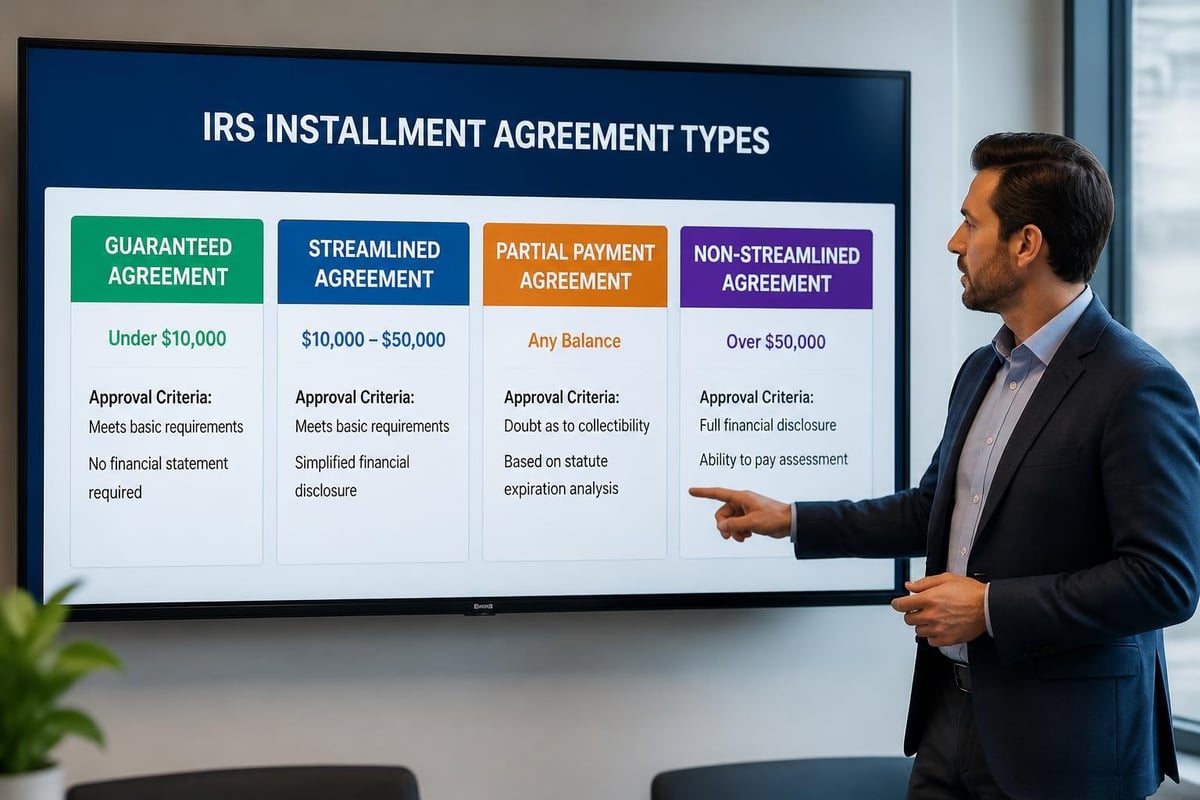
The IRS offers several flavors, each with different requirements and approval thresholds.
Guaranteed installment agreement: You owe $10,000 or less, haven't defaulted on an installment agreement in the past five years, can pay in full within three years, and filed all required returns. The IRS must approve you. No financial statement needed.
Streamlined installment agreement: You owe $50,000 or less (combined tax, penalties, interest) and can pay within 72 months or before the collection statute expires, whichever is shorter. You file Form 9465 or apply online. The IRS usually approves without demanding a detailed financial statement, though they can ask if something seems off.
Partial payment installment agreement (PPIA): You can't pay the full debt before the statute expires. The IRS accepts less than full payment, based on your ability to pay. Requires Form 433-A (individuals) or Form 433-B (businesses), full financial disclosure, and renewal every two years. The IRS will file a lien.
Non-streamlined installment agreement: You owe more than $50,000 or need longer than 72 months. Full financials required, negotiation expected, and liens likely.
How to Apply for a Tax Installment Plan
You apply using Form 9465, online through the IRS payment portal, or by phone. The IRS instructions for Form 9465 walk through the process and fee schedules. Online applications cost less and process faster.
Start by determining your proposed monthly payment. Divide your total balance by 72 months for streamlined deals. If that doesn't fit your cash flow, you'll need financials to justify a lower amount.
Required Documentation
If you're seeking a streamlined agreement under $50,000, you typically don't need to submit a financial statement. The IRS accepts your proposed payment if it clears the balance within the timeframe.
Above that threshold, or if your proposed payment seems too low, you'll submit:
- Form 433-F (Collection Information Statement) for most individuals
- Form 433-A for partial payment or non-streamlined cases
- Form 433-B if you're a self-employed business owner or corporation
- Three months of bank statements, sometimes six
- Proof of income – pay stubs, profit-and-loss statements, 1099s
- Proof of expenses – rent/mortgage, utilities, insurance, car payments
The IRS uses these to calculate your reasonable collection potential. They compare your income to allowable living expenses (based on IRS standards, not your actual spending), then decide what you can afford to pay monthly.
Fees and Costs of a Tax Installment Plan
The IRS charges setup fees. As of 2026, the standard fee for a new agreement is $130 if you apply online, $225 if you apply by phone, mail, or in person. Low-income taxpayers can request a fee waiver or reduction to $43 if household income is at or below 250% of the federal poverty level.
If you agree to direct debit (automatic monthly withdrawal from your checking account), the setup fee drops to $107 for online applications or $130 for paper. Reimbursement of the setup fee is available for low-income taxpayers after the agreement successfully concludes.
| Application Method | Standard Fee | Direct Debit Fee | Low-Income Fee |
|---|---|---|---|
| Online | $130 | $107 | $43 (or waived) |
| Phone, mail, in-person | $225 | $130 | $43 (or waived) |
You'll also pay interest on the unpaid balance. The IRS compounds daily at the federal short-term rate plus 3%, adjusted quarterly. As of October 2026, that's around 8% annually. Penalties continue to accrue, too – the failure-to-pay penalty drops from 0.5% per month to 0.25% per month once your agreement is active and you're making payments on time.
Do the math. A $30,000 debt paid over 72 months at 8% interest and ongoing penalties will cost you several thousand dollars more than the principal. That's the price of time.
What Happens After Approval
Once approved, you receive a confirmation letter stating your monthly payment amount, due date (usually the 28th of each month), and payment method. The IRS will not levy your wages or bank accounts as long as you stay current. But they may still file a Notice of Federal Tax Lien.
Lien Filings
A lien is public notice that the IRS has a legal claim to your property. It doesn't seize anything, but it wrecks your credit and complicates refinancing or selling assets.
The IRS generally files liens when:
- Your balance exceeds $10,000 (though policy and discretion vary)
- You're on a partial payment installment agreement
- Your payment term stretches beyond a few years
You can request lien withdrawal after paying in full, or sometimes after establishing a strong payment history and meeting other criteria. But don't count on it while you're still paying.

Defaulting on Your Installment Agreement
You default if you miss a payment, fail to file a required return, or incur new tax debt. The IRS sends a notice of intent to terminate, usually giving you 30 days to cure the default.
If you don't respond or can't cure, the agreement ends. Collection resumes. Levies, garnishments, and seizures are back on the table. The official IRS overview of payment plans warns that reinstating a defaulted agreement costs another setup fee and may require updated financials.
How to Avoid Default
Set up automatic payments. Direct debit from your checking account eliminates the chance you forget. The IRS prefers it, charges less for it, and processes it reliably.
File every return on time while your agreement is active. If you owe more in 2026 while paying off 2023, you've defaulted even if you're current on the old debt. File the return, pay what you can, and amend your agreement if needed.
Keep the IRS informed if your financial situation changes. If you lose your job or face a medical emergency, call before you miss a payment. The IRS can grant short-term relief, restructure your agreement, or pause payments temporarily in some cases.
Alternatives to a Tax Installment Plan
An installment agreement is rarely the only option. Sometimes it's not even the best one.
Offer in Compromise
An Offer in Compromise (OIC) settles your debt for less than the full amount. You prove you can't pay in full before the collection statute expires, and the IRS accepts a lump sum or short-term payment plan. Approval rates hover around 30%, and the process takes months. But if you qualify, you eliminate the debt permanently instead of dragging it out for years.
The IRS compares your reasonable collection potential to your offer. If your offer exceeds what they could realistically collect, they accept. If not, they counter or reject.
Currently Not Collectible Status
If you can't afford any payment, the IRS can place your account in Currently Not Collectible (CNC) status. Collection stops. No monthly payments. The debt remains, interest accrues, and the IRS can refile liens or revisit your status annually. But you're not hemorrhaging cash every month to an installment plan you can't sustain.
CNC works when your allowable expenses equal or exceed your income, leaving no disposable income for the IRS. You submit the same financial forms as you would for a non-streamlined installment agreement, but the conclusion is different.
Short-Term Payment Plan
If you can pay in full within 180 days, request a short-term payment plan instead of a formal installment agreement. No setup fee. Same relief from levies. You just need a plan to clear the balance quickly – a pending bonus, a tax refund, a maturing CD.
The IRS grants short-term extensions more freely than long-term agreements. You're promising resolution, not years of monthly checks.
Comparing Installment Agreements to Consumer Credit
A tax installment plan is not a loan. You can't discharge it in bankruptcy the way you might a credit card. The IRS has collection powers no private creditor enjoys – wage garnishment without a lawsuit, bank levies with minimal notice, property seizure.
Some taxpayers consider borrowing from a bank, credit union, or even a Buy Now, Pay Later service to pay the IRS in full. The logic: trade IRS debt for private debt with better terms, fewer penalties, or lower interest.
That works if you qualify for a personal loan at a competitive rate and your credit can handle the inquiry and new account. It doesn't work if you're already overextended or the loan rate exceeds the IRS rate plus penalties.
When Borrowing Makes Sense
- Your credit score is strong (700+)
- You can secure a loan at 6% or less
- The loan has no prepayment penalty
- Paying the IRS in full eliminates the risk of liens and levies
When It Doesn't
- Your credit is damaged and the only available rate is 15%+
- You're trading unsecured IRS debt for secured debt (like a home equity loan risking your house)
- You're using high-interest credit cards or payday-style products
The IRS isn't going anywhere. Their interest rate is predictable, and their installment terms are flexible. Borrowing to pay them trades one creditor for another, sometimes at worse terms.
Business Tax Installment Plans
If you're a business owner with payroll tax debt, the rules tighten. The IRS treats trust fund taxes – the employee portion of Social Security and Medicare you withheld but didn't remit – as sacrosanct. They'll push harder, accept less flexibility, and pursue responsible persons individually under the Trust Fund Recovery Penalty.
You can still get an installment agreement for business taxes, but expect:
- Shorter payment terms – often 24 months, rarely beyond 36
- Mandatory direct debit in many cases
- Current payroll tax compliance as a condition – fall behind on this quarter's deposits and your agreement terminates
- Personal liability for officers, owners, and anyone who had authority over funds
Submit Form 433-B, provide business financials, and demonstrate that your proposed payment won't sink the business. The IRS wants their money, but they also want you operating and filing returns. A dead business pays nothing.

How Long a Tax Installment Plan Can Last
The collection statute expires 10 years from the date the IRS assesses your tax. After that, they can't collect (with exceptions for bankruptcy, offers, and certain other actions that suspend the clock). Your installment agreement must conclude before the statute runs, or the IRS will demand a larger monthly payment.
If you owe $60,000 and the statute expires in 7 years (84 months), the IRS won't approve a 72-month streamlined plan unless you can pay enough monthly to clear the balance by month 84. If your proposed payment doesn't hit that target, you'll need a partial payment installment agreement or another approach.
Stretching the agreement close to the statute expiration is common in partial payment deals. You pay what you can, the statute runs, and the remaining balance disappears. The IRS knows this and scrutinizes these agreements carefully, requiring financial updates every two years.
State Tax Installment Plans
Most states offer their own installment programs for income tax, sales tax, and other liabilities. The terms vary wildly – some states are easier than the IRS, others far stricter.
If you owe both federal and state tax, prioritize the IRS. Federal liens preempt state claims in many cases, federal penalties compound faster, and the IRS has more aggressive collection tools. But don't ignore state debt. States can suspend business licenses, revoke professional credentials, and intercept lottery winnings or vendor payments.
You'll usually apply separately for state and federal agreements. Paying one doesn't automatically satisfy the other, and defaulting on one doesn't terminate the other (though it signals financial distress that both may investigate).
Records You Need to Maintain
While your tax installment plan is active, keep every payment confirmation, bank statement showing debits, and IRS correspondence. The IRS's records are good but not infallible. Payments get misapplied, automatic debits fail without notice, and balances don't always reconcile.
Check your IRS account transcript monthly using the IRS online portal. Confirm each payment posted, verify the balance is dropping, and watch for new assessments or adjustments. If something's wrong, call immediately. Don't wait for a default notice.
Keep copies of:
- Your installment agreement approval letter
- Every payment receipt or bank debit confirmation
- IRS transcripts showing payments and balance changes
- Any correspondence modifying your agreement
If you later need to prove compliance, reinstate a defaulted agreement, or challenge a collections action, these records are your defense.
When Professional Help Pays
You can apply for a tax installment plan yourself. The forms are public, the process is documented, and the IRS will work with you. But professionals – enrolled agents, CPAs, tax attorneys – bring leverage you don't have.
We know which IRS employees have discretion, which arguments move cases, and how to structure an agreement that minimizes cost and risk. We can request partial payment terms when the IRS initially demands full pay, negotiate lien withdrawals, and push back on unreasonable financial disclosures.
If your debt exceeds $50,000, involves business taxes, or includes penalties you believe are incorrect, representation changes outcomes. If you're facing levy action or default, the cost of help is usually less than the cost of fumbling through it alone.
The Journal of Accountancy has covered cases where installment agreements interact with Department of Justice referrals and other collection issues – nuances that matter when your case isn't straightforward.
Final Payment and What Comes After
When you make your last payment, request a payoff letter and final account transcript. Confirm the balance is zero and no additional penalties or interest accrued after your final payment posted. The IRS sometimes assesses small amounts of residual interest that didn't make it onto your last statement.
If a lien was filed, request withdrawal after confirming zero balance. The lien won't disappear automatically. You submit Form 12277 (Application for Withdrawal of Filed Form 668(Y), Notice of Federal Tax Lien) along with proof of full payment. Withdrawal removes the lien from public record and helps repair your credit.
If you qualified for a low-income setup fee reduction, you can request reimbursement of that fee after successful completion. The IRS will issue a refund check if you meet the criteria and apply.
Keep your completion records permanently. If the IRS later claims you still owe (due to a processing error or misapplied payment), those records prove you satisfied the debt.
A tax installment plan buys time and stops levies, but it's not free money. You'll pay interest, fees, and possibly penalties for years. The key is knowing your options, applying correctly, and staying compliant once approved. If you're managing federal tax debt and need someone who understands both the planning side and the resolution side, Taxt works exclusively with U.S. taxpayers to reduce tax, build wealth, and keep the IRS at arm's length.