If you've got an IRS letter on your desk right now, you have a decision to make, and the clock matters. I'm Darrin Mish. I've spent 32 years helping people with exactly this kind of situation. Here's what you should do.
I'm Darrin Mish. Tampa tax attorney, 32 years in, more than $100 million in IRS debt resolved. That's my resolution practice. What follows is the other side of the desk – the planning moves that keep you from ever needing it.
Most business owners treat financial taxes as a compliance problem. File returns, pay the bill, repeat next year. That's backward. Financial taxes are a planning problem, and they show up in every corner of your financial life – payroll, investment income, retirement accounts, business structure, estate transfers.
The IRS publishes hundreds of pages on tax topics each year. Your CPA focuses on compliance, filing accurate returns based on what already happened. Strategic planning happens before the transaction, before the income hits your account, before the structure is set.
Understanding Financial Taxes Across Categories
Financial taxes don't fit in one bucket. The term covers any tax obligation arising from your financial activities – earning, investing, transferring wealth, operating a business.
Each category has different rates, timing rules, and planning opportunities. Miss the distinctions and you overpay.
Income Taxes on Business Operations
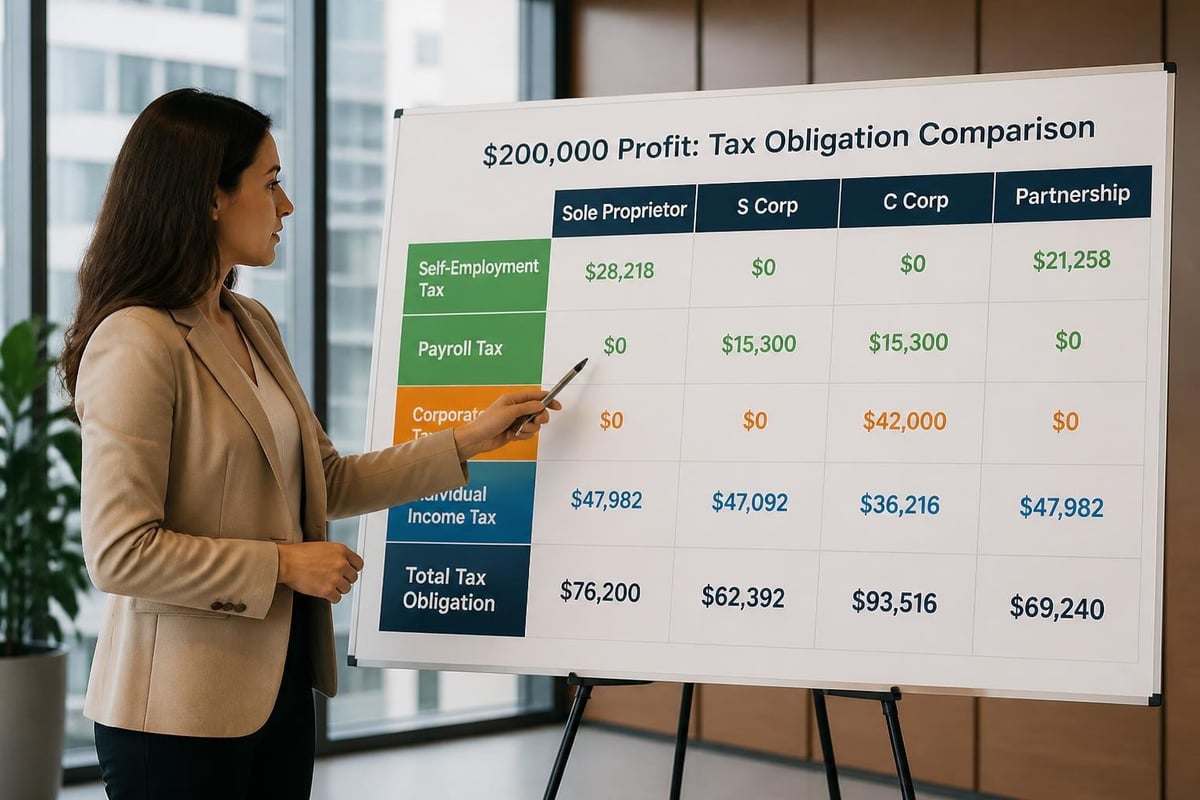
Your business structure determines how financial taxes apply to operating income. Sole proprietors report everything on Schedule C. S corporations split income between wages and distributions. C corporations face double taxation.
Key distinctions:
- Ordinary income taxed at graduated rates up to 37%
- Self-employment tax adds 15.3% on net earnings for sole proprietors and partnerships
- Qualified Business Income deduction reduces taxable income by up to 20% for pass-through entities
- Corporate rates flat at 21% since 2018
The planning happens when you choose your entity and decide how to extract profit. Wages trigger payroll taxes but create retirement plan deductions. Distributions avoid FICA but don't fund 401(k) contributions.
Investment Income and Capital Gains
Investment activity generates its own set of financial taxes. Interest, dividends, capital gains, and losses each follow separate rules under IRS Publication 550.
Ordinary dividends and interest tax at your regular income rate. Qualified dividends and long-term capital gains get preferential rates: 0%, 15%, or 20% depending on your taxable income.
The Net Investment Income Tax adds 3.8% on top when your modified adjusted gross income exceeds $200,000 single or $250,000 married filing jointly. That's a surtax specifically on investment earnings.
| Investment Type | Holding Period | Tax Rate | Additional Tax |
|---|---|---|---|
| Interest income | N/A | Ordinary (up to 37%) | Possible 3.8% NIIT |
| Non-qualified dividends | N/A | Ordinary (up to 37%) | Possible 3.8% NIIT |
| Qualified dividends | 60+ days | 0%, 15%, or 20% | Possible 3.8% NIIT |
| Short-term capital gains | Under 1 year | Ordinary (up to 37%) | Possible 3.8% NIIT |
| Long-term capital gains | 1 year+ | 0%, 15%, or 20% | Possible 3.8% NIIT |
Timing matters. Sell stock after 364 days, you pay ordinary rates. Wait one more day, you cut the rate in half for most taxpayers.
Retirement Account Tax Advantages
Retirement accounts exist to defer financial taxes. Traditional 401(k) and IRA contributions reduce your current taxable income. The money grows tax-deferred. You pay ordinary income tax on withdrawals.
Roth accounts flip the script. No deduction now, but qualified withdrawals come out tax-free. You're betting your tax rate will be higher in retirement.
Contribution limits for 2026:
- 401(k): $23,500 employee deferral ($31,000 age 50+)
- Solo 401(k): Up to $70,000 total including employer contributions ($77,500 age 50+)
- Traditional and Roth IRA: $7,000 ($8,000 age 50+)
- SEP IRA: Lesser of 25% compensation or $70,000
Business owners have more options. Solo 401(k) plans let you contribute as both employee and employer. SEP IRAs allow larger contributions with simpler administration. Cash balance plans can shelter $200,000+ annually if your income supports it.
The planning question: Do you want the deduction now or tax-free income later? Your current marginal rate versus your expected retirement rate determines the answer.
Estate and Transfer Tax Considerations
Estate taxes represent another category of financial taxes. The federal estate tax exemption sits at $13.99 million per person for 2026. Anything above that threshold faces a 40% tax.
Without planning, a couple's estate can lose millions. With planning, you use annual gift exclusions, lifetime exemptions, trusts, and valuation discounts to move assets out of your taxable estate.
The annual gift exclusion lets you give $19,000 per recipient in 2026 without filing a gift tax return. A couple can give $38,000 to each child, each grandchild, each year. That removes growth from your estate and doesn't count against your lifetime exemption.
IRS Publication 559 covers estate administration and the filing requirements. Form 706 is due nine months after death if the gross estate exceeds the exemption amount.
State estate taxes add another layer. Seventeen states and the District of Columbia impose their own estate or inheritance taxes. Many have exemptions far below the federal level. Plan for both.
Step-Up in Basis Rules
Assets transferred at death receive a step-up in basis to fair market value. That eliminates built-in capital gains.
Example: You bought stock for $100,000 that's now worth $1 million. Sell it during life, you pay capital gains tax on $900,000. Die holding it, your heirs receive it at $1 million basis. They can sell immediately with zero gain.

That's a massive financial tax advantage. It changes the calculus on when to harvest gains, which assets to gift versus hold, and how to structure your portfolio as you age.
Gifts during life carry over your basis. The recipient inherits your low basis and will pay capital gains tax when they sell. Sometimes that's fine. Other times, holding the asset until death saves six figures in tax.
State and Local Financial Taxes
State income taxes range from zero to over 13%. Nine states have no income tax: Alaska, Florida, Nevada, New Hampshire, South Dakota, Tennessee, Texas, Washington, and Wyoming.
High-tax states like California (13.3%), New York (10.9%), and New Jersey (10.75%) make domicile planning relevant for business owners with flexibility. Establish domicile in a low-tax state, and you eliminate state tax on all income.
Tax policy research shows businesses increasingly consider state tax burden when choosing locations. Remote work accelerated the trend.
You can't just claim domicile wherever you want. States look at where you spend time, where your family lives, where you vote, where your professional licenses are registered. Change domicile poorly and you'll defend an audit.
Local Taxes on Business Activity
Cities and counties add their own financial taxes. Some impose gross receipts taxes regardless of profitability. Others tax business personal property – furniture, equipment, computers.
Sales tax compliance creates exposure when you have nexus in multiple states. Economic nexus laws now trigger filing requirements based on sales volume alone, even without physical presence.
The Supreme Court's 2018 Wayfair decision changed everything. Each state sets its own threshold. Exceed it, and you're collecting and remitting sales tax.
Corporate Tax Planning Opportunities
C corporations face unique financial taxes. Profits are taxed at the entity level at 21%. Distributions to shareholders as dividends face individual income tax. That's double taxation.
But corporate structure creates planning opportunities other entities don't have. You can retain earnings, deduct certain fringe benefits, and time income recognition differently.
Recent corporate tax reform analysis explores how policy changes have shifted toward cash flow taxation and away from traditional income measures. The business interest deduction limitation and bonus depreciation changes affect planning.
Planning considerations for C corporations:
- Salary versus dividend mix to minimize total tax
- Timing of Subchapter S election to avoid double tax
- Qualified Small Business Stock exclusion for startup equity
- Section 1202 can exclude up to $10 million in gain on QSBS held five years
Section 1202 alone justifies C corporation status for many startups. Exclude $10 million in gain per shareholder, per company. Stack multiple C corps and you multiply the exclusion.
Pass-Through Entity Elections
S corporations and partnerships avoid entity-level tax. Income flows to owners and gets taxed once on individual returns.
The Qualified Business Income deduction (Section 199A) lets you deduct up to 20% of qualified business income from pass-through entities. That drops your effective rate on business income significantly.
Not all income qualifies. Specified Service Trade or Businesses (lawyers, doctors, consultants, financial advisors) face phase-outs above $197,300 single or $394,600 married filing jointly in 2026.

Plan your income to stay under the threshold or structure your business to maximize the deduction if you're above it. W-2 wages and qualified property create a safe harbor.
Payroll Tax Obligations
Employment creates financial taxes beyond income tax. Employers pay Social Security tax (6.2% on wages up to $176,100 in 2026) and Medicare tax (1.45% on all wages, plus 0.9% Additional Medicare Tax on high earners).
Employees pay matching amounts. Self-employed individuals pay both halves as self-employment tax, though they deduct half on their return.
Misclassify workers as independent contractors when they should be employees, and you'll pay those taxes retroactively plus penalties. The IRS and Department of Labor scrutinize classification.
Worker classification factors:
- Behavioral control: Does the company direct how work is performed?
- Financial control: Who provides tools, who bears risk of profit or loss?
- Relationship type: Written contracts, benefits, permanency
States impose their own payroll taxes – unemployment insurance, disability insurance, workers' compensation. Rates vary by industry and claims history.
Plan your payroll strategy around reasonable compensation standards. S corporation owners must pay themselves reasonable wages before taking distributions. Too low, and the IRS recharacterizes distributions as wages.
Minimizing Financial Taxes Through Planning
Tax planning reduces financial taxes by structuring transactions before they occur. Timing income and deductions. Choosing the right entity. Using retirement accounts strategically. Documenting business expenses properly.
You can't eliminate taxes. You can position yourself to pay the legal minimum.
High-impact planning strategies:
- Maximize retirement contributions to defer ordinary income
- Harvest tax losses to offset capital gains
- Bunch deductions in high-income years if you itemize
- Use Section 179 and bonus depreciation to accelerate deductions on equipment purchases
- Split income with family members through employment or entity ownership (within reasonable compensation limits)
- Time asset sales to qualify for long-term capital gains rates
- Donate appreciated assets to charity instead of cash to avoid capital gains
The Section 179 expensing election lets you deduct up to $1,220,000 in equipment purchases in 2026 instead of depreciating over years. Bonus depreciation allows 60% expensing on top of that for most new property.
Buy a $150,000 vehicle for business use in December, and you could deduct most of it in the current year. That shifts taxable income forward and gives you cash flow flexibility.
Record-Keeping and Compliance Requirements
Financial taxes require documentation. The IRS can audit returns for three years after filing in most cases, six years if you underreport income by more than 25%.
Essential records to maintain:
- Bank and credit card statements showing business transactions
- Receipts for deductible expenses
- Mileage logs for vehicle deductions
- Home office measurements and expense allocation worksheets
- Depreciation schedules for assets
- Stock purchase and sale records with adjusted basis calculations
- Retirement account contribution records
Most audits fail on documentation, not law. You had the expense, but you can't prove it. The deduction gets disallowed.
Cloud accounting software helps. Sync bank feeds, categorize transactions, store receipt images. The system creates an audit trail automatically.
Separate business and personal finances. Commingling funds creates confusion and undermines your corporate veil if you're audited. One business checking account, one business credit card minimum.
Estimated Tax Payment Strategy
Financial taxes are pay-as-you-go. Employees have withholding. Business owners make quarterly estimated payments.
Underpay by more than 10%, and you owe penalties. The safe harbor: Pay 100% of last year's tax (110% if your adjusted gross income exceeded $150,000) or 90% of current year's tax.
Calculate estimates using Form 1040-ES. Due dates are April 15, June 15, September 15, and January 15 of the following year.
| Quarter | Period Covered | Due Date |
|---|---|---|
| Q1 | January 1 – March 31 | April 15 |
| Q2 | April 1 – May 31 | June 15 |
| Q3 | June 1 – August 31 | September 15 |
| Q4 | September 1 – December 31 | January 15 (next year) |
Adjust estimates when income changes mid-year. Sold a business in Q3? Increase your September and January payments to avoid underpayment penalties.
You can also annualize income using Schedule AI. That lets you match estimated payments to when you actually earned the income. Helpful if your income is uneven through the year.
Financial taxes require year-round attention, not just April scrambling. Plan ahead, document everything, and structure transactions with tax impact in mind. The opportunities compound when you see the full picture: income timing, entity choice, retirement funding, estate positioning, and expense planning all working together. Taxt walks U.S. business owners through a five-step planning process that connects these pieces, reduces what you legally owe, and eliminates the anxiety that comes from wondering if you missed something.