
After 32 years of IRS work — and more than $100 million in resolved tax debt — I've seen just about every version of the problem you're dealing with. I'm Darrin Mish, a tax attorney in Tampa. Here's what you should know.
I'm Darrin Mish. Tampa tax attorney, 32 years in, more than $100 million in IRS debt resolved. That's my resolution practice. What follows is the other side of the desk – the planning moves that keep you from ever needing it.
Your father dies. He leaves you his IRA. The bank sends forms. Your brother wants his share. And somewhere in there, tax decisions get made that will cost you thousands. Parent relief IRAs – the assets parents leave behind and the tax consequences that follow – operate under rules most families discover too late.
The 10-Year Rule Changed Everything
The SECURE Act of 2019 eliminated the stretch IRA for most beneficiaries. Your parents could stretch distributions across their lifetime. You get ten years. Period.
If your parent died before their required beginning date (April 1 of the year after turning 73), you have flexibility within that decade. No annual minimums. Just empty the account by December 31 of the tenth year following their death.
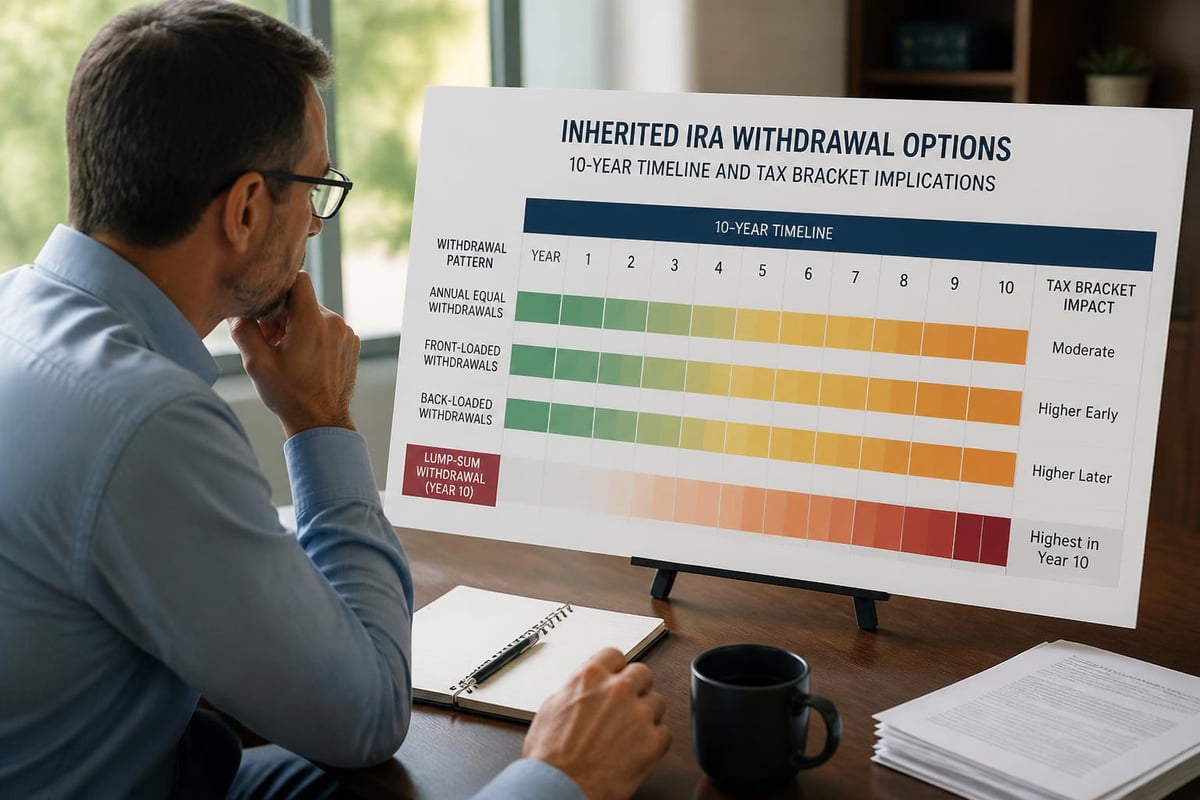
That flexibility is dangerous. Most beneficiaries do nothing for nine years, then take a massive distribution in year ten. They spike their income, jump tax brackets, and trigger Medicare premium surcharges. The IRS collects far more than if distributions were planned strategically.
If your parent died after their required beginning date, you face annual distribution requirements plus the ten-year deadline. The IRS hasn't been clear about whether annual RMDs apply during years one through nine for post-RBD deaths. Guidance shifted in 2022. Penalties were waived. Clarity remains elusive.
Who Gets the Stretch Exception
Four categories of beneficiaries still get the old stretch rules for parent relief IRAs:
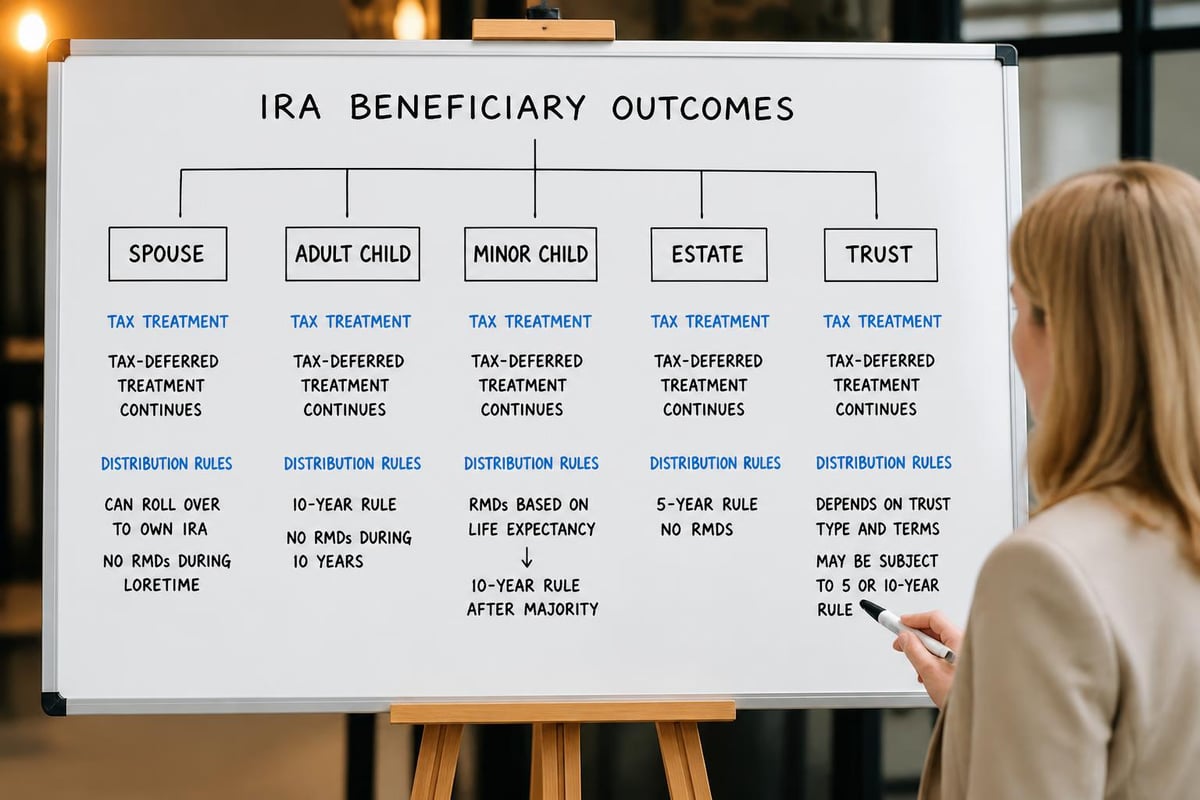
- Surviving spouses (can treat the IRA as their own)
- Minor children (until age of majority, then 10-year clock starts)
- Disabled individuals (meeting strict IRS definitions)
- **Beneficiaries less than ten years younger than the deceased
Everyone else gets the decade window. Your 45-year-old daughter inherits your IRA? Ten years. Your 35-year-old son? Same. The stretch is dead for most families.
Spouses have the best options. They can roll the inherited IRA into their own IRA, delay RMDs until their own required beginning date, and name new beneficiaries. Or they can remain a beneficiary and use the longer of their life expectancy or the deceased spouse's.
Distribution Planning Across Tax Years
The ten-year window is not a suggestion to wait ten years. It's a planning opportunity most families waste.
Here's what competent planning looks like: Map your projected income for the next decade. Identify low-income years. Take larger distributions those years. Avoid distributions in high-income years if possible.
You inherit $500,000 from your father's IRA in 2026. You're 52, earning $180,000 annually. In 2027, your spouse takes parental leave. Your household income drops to $120,000. That's your year for a $150,000 distribution. You fill the 22% bracket instead of pushing income into 32% or 35% brackets in other years.
| Strategy | Tax Outcome | Long-Term Cost |
|---|---|---|
| Wait until year 10, take lump sum | Spike into top bracket, Medicare surcharges | High |
| Equal annual distributions | Predictable but ignores income variations | Medium |
| Strategic distributions in low-income years | Fills lower brackets efficiently | Low |
| Roth conversions in low years | Tax now at known rates, tax-free growth after | Lowest if done right |
The inherited IRA doesn't get a step-up in basis. Every dollar comes out as ordinary income. No capital gains treatment. No special breaks. Understanding how inherited IRAs are taxed prevents costly surprises.
When Roth Conversions Make Sense
If you inherit a traditional IRA and your income is temporarily low, consider converting portions to your own Roth IRA. You'll pay tax now at lower rates. The converted amount grows tax-free from that point forward.
This works particularly well if you're between jobs, semi-retired, or experiencing a business loss year. You're going to pay tax on the inherited IRA anyway. The question is whether you pay at 12% now or 32% later.
You cannot roll an inherited IRA from a parent into your own IRA. That's only available to spouses. But you can take distributions and immediately contribute to your own Roth IRA up to annual limits, paying tax on the distribution.
Multiple Beneficiaries Create Complications
Your father names three children as equal beneficiaries on his IRA. All three must use the ten-year rule (assuming none qualify for exceptions). But they don't have to take distributions on the same schedule.
Separate inherited IRAs by December 31 of the year following death. This allows each beneficiary to manage their own distributions and tax planning. Without separation, the beneficiary with the shortest life expectancy (or most restrictive rule) determines RMDs for everyone.
One sibling might be in peak earning years, wanting to minimize distributions. Another might be retired with low income, making larger distributions tax-efficient. Separation allows individualized planning.
Problems arise when beneficiaries want different things from the same account. Your sister needs cash now. You want to defer. Your brother wants to argue about investment choices. Separate the accounts early.
Estate IRAs and Delayed Distributions
If your parent's estate is named as beneficiary (terrible planning, but common), the IRA loses all stretch provisions. The estate must distribute under the fastest schedule: five years if death occurred before required beginning date, or the deceased's remaining life expectancy if after.
Estates don't have life expectancies. They can't stretch. The ten-year rule for individual beneficiaries looks generous by comparison.
This happens when beneficiary forms weren't updated after divorce, or when parents named their estate thinking it simplified things. It doesn't. It accelerates taxation and eliminates planning flexibility.
Tax Planning Beyond Distributions
Parent relief IRAs affect more than just income tax. They influence your financial aid calculations if you have college-age children. They impact Roth conversion opportunities. They determine whether you face net investment income tax.
Distributions from inherited IRAs count as income for determining modified adjusted gross income. This affects:
- Medicare Part B and Part D premiums (IRMAA surcharges kick in at $106,000 for individuals in 2026)
- Premium tax credits for marketplace health insurance
- Financial aid formulas for college (FAFSA treats IRA distributions as income)
- Net investment income tax (3.8% surtax above $200,000/$250,000)
A $100,000 inherited IRA distribution might cost you $24,000 in federal tax if you're in the 24% bracket. But it could also trigger $2,000 in extra Medicare premiums and $3,800 in net investment income tax. Total hit: $29,800.
Qualified Charitable Distributions Don't Work
You cannot make qualified charitable distributions from an inherited IRA unless you inherited it from your spouse and rolled it into your own IRA. QCDs require you to be over 70½ and distribute from your own IRA, not an inherited account.
This eliminates a valuable planning tool. If you're charitably inclined and over 70½, you might take a distribution from the inherited IRA, pay the tax, and then make a QCD from your own IRA up to the $105,000 limit in 2026.
The IRS provides comprehensive guidance on IRA rules that applies to both traditional and inherited accounts, though the inherited versions have their own complications.
Mistakes That Cost Families Thousands
Missing the December 31 deadline in year ten. The entire remaining balance becomes taxable that year. The IRS doesn't extend this deadline. Miss it and face a massive tax bill plus potential penalties.
Taking distributions without considering state taxes. If you inherit an IRA while living in a high-tax state and plan to retire to Florida or Texas, defer distributions until after the move. State tax rates matter.
Ignoring the five-year rule for Roth IRAs. If you inherit a Roth IRA and your parent held it for less than five years, earnings are taxable when distributed. Contributions come out tax-free, but growth doesn't if the five-year holding period hasn't been met.
Failing to update beneficiaries on the inherited account. You inherit an IRA from your father. You die three years later. If you didn't name beneficiaries on the inherited IRA, it goes to your estate. Your kids lose years of tax-deferred growth.
| Common Mistake | Why It Happens | Fix |
|---|---|---|
| Waiting until year 10 | Procrastination, lack of planning | Annual distribution schedule based on income projections |
| Not separating accounts | Siblings want to stay connected | Separate by Dec 31 of year after death |
| Ignoring state tax planning | Focus only on federal | Consider move timing if relocating to low-tax state |
| Missing basis tracking on non-deductible contributions | Poor records | Recover basis documentation immediately |
Cashing out immediately. Some beneficiaries take the entire inherited IRA as a lump sum within months of receiving it. They pay tax at the highest rates and lose years of tax-deferred compounding.
When Early Distributions Make Sense
Hardship exceptions for penalty-free IRA withdrawals generally don't apply to inherited IRAs because you're past 59½ age requirements. But there are times when accelerated distributions make strategic sense.
If you expect tax rates to rise significantly, either due to legislation or your own income trajectory, paying tax now might beat paying later. If you're in the 12% bracket this year and expect to be in the 32% bracket for the rest of the decade, take more now.

If you have high-interest debt, using inherited IRA funds to eliminate it can make mathematical sense. Paying 24% tax to eliminate 8% debt doesn't pencil out. But if you're carrying credit card debt at 22% and facing financial stress, the calculation changes.
Trust as Beneficiary Restrictions
Some parents name trusts as IRA beneficiaries, usually for asset protection or control purposes. This creates complex distribution rules depending on whether the trust qualifies as a see-through trust.
Conduit trusts pass all IRA distributions immediately to trust beneficiaries. These qualify for look-through treatment. The IRS ignores the trust and applies rules based on the oldest beneficiary.
Accumulation trusts can hold distributions inside the trust. These face the compressed trust tax brackets, hitting the top 37% rate at just $15,200 of income in 2026.
If you're creating estate plans involving IRAs, understand that trust beneficiaries lose flexibility. The trustee controls distribution timing within the ten-year window, not the beneficiaries. This prevents poor decisions by young beneficiaries but also prevents optimal tax planning.
Required Minimum Distribution Penalties
The penalty for missing required distributions from inherited IRAs was 50% of the shortfall. The SECURE 2.0 Act reduced it to 25% starting in 2023, and down to 10% if corrected promptly.
Still painful. If you were required to distribute $20,000 and took nothing, that's a $2,000 penalty (plus the tax you owe on the $20,000). The IRS has been lenient during the transition years while finalizing guidance, but don't count on continued forgiveness.
Document everything. Keep records of the date of death, account values, beneficiary designations, and distribution calculations. If the IRS questions your distributions five years later, you'll need proof.
Non-Spouse Rollovers Are Prohibited
You cannot roll an inherited IRA from a parent into your own IRA. Many beneficiaries ask about this. The answer is always no for non-spouse beneficiaries.
You must keep it titled as an inherited IRA: "John Smith (deceased January 15, 2026) IRA F/B/O Jane Smith." That titling preserves the inherited status and makes clear which rules apply.
You can move the inherited IRA between custodians through trustee-to-trustee transfer. Want to move from your father's bank to your brokerage? That's allowed. Just maintain the inherited IRA designation.
Spouses have the rollover option. A surviving spouse can treat the inherited IRA as their own, retitling it completely. This restarts RMD calculations based on the spouse's age and allows naming new beneficiaries who could then stretch over their own life expectancies (though they'd still face the ten-year rule in most cases).
Investment Decisions During the Ten Years
Your inherited IRA continues growing (or shrinking) based on investment performance during the ten-year window. Conservative investors sometimes make the mistake of holding everything in cash.
If you plan to take distributions across the full decade, the account should remain invested appropriately. A 45-year-old with $500,000 in an inherited IRA and ten years to distribute might keep 60% in equities, taking distributions from the bond allocation in down markets.
The tax tail shouldn't wag the investment dog, but tax consequences matter. Capital gains inside the IRA are irrelevant since everything comes out as ordinary income anyway. This actually argues for more aggressive positioning if your timeframe allows.
State-Specific Inherited IRA Considerations
Some states tax inherited IRAs differently than federal law. Pennsylvania exempts IRA distributions from state income tax. New Jersey has complex rules about what qualifies for exclusion. California, at the other end, taxes everything.
If you inherit an IRA while residing in one state and later move, the distributions are taxable in your state of residence when taken, not where the decedent lived or where you lived when they died.
This creates planning opportunities. Inherit while living in California, planning to retire to Nevada? Defer distributions until after the move. Save 13.3% on the highest brackets.
Some states impose their own estate or inheritance taxes that could affect the IRA before you receive it. But most state inheritance taxes exempt transfers to children. Check your specific state's rules.
Planning Before You Inherit
The best parent relief IRAs planning happens before death, when your parents can still make beneficiary decisions. If you're expecting to inherit, consider these conversations:
Ask about beneficiary designations. Are they current? Do they reflect your parents' wishes? Are they coordinated with estate plans?
Discuss Roth conversions. Your parents might be in lower brackets than you. If they convert to Roth, you inherit tax-free growth. They pay the tax at their rates, you avoid it entirely.
Consider life expectancy differences. If one parent is significantly older or has health issues, review which assets each owns. The older parent might hold Roth IRAs, the younger holds traditional IRAs, minimizing RMDs.
Update after major life events. Divorce, remarriage, births, deaths – all should trigger beneficiary reviews. Old beneficiary designations cause more problems than any other estate planning failure.
Your parents' CPA might not be thinking about your tax situation when planning their distributions. Forbes discusses recent relief measures that affect how beneficiaries manage inherited accounts, but most of this planning requires foresight.
Parent relief IRAs operate under rules designed to accelerate tax collection, not optimize your financial situation. The ten-year window creates planning opportunities if you recognize them early, but most families don't engage until it's too late to implement the best strategies. Whether you're managing an inherited IRA now or expect to inherit in the future, Taxt provides the strategic tax planning that turns these deadlines into opportunities, with guaranteed savings that go beyond what conventional compliance work delivers.