Most people I talk to about their IRS problem have already built the worst-case scenario in their head. The reality is usually much more manageable. I'm Darrin Mish, and I've been representing taxpayers before the IRS for 32 years. Here's what actually tends to happen.
I'm Darrin Mish. Tampa tax attorney, 32 years in, more than $100 million in IRS debt resolved. That's my resolution practice. What follows is the other side of the desk – the planning moves that keep you from ever needing it.
You run your own business. The income swings. The quarterly estimates sting. And somewhere in the back of your mind sits the question: how do I save for retirement when I don't have an employer match?
The self employed Roth IRA conversation usually stops at the $7,000 annual limit ($8,000 if you're 50 or older). That's the standard contribution cap for 2026. But if that's all you're doing, you're leaving serious wealth-building capacity on the table. The real planning happens when you stack vehicles, understand the income phase-outs, and coordinate traditional and Roth buckets across multiple account types.
The Basic Self Employed Roth IRA Mechanics
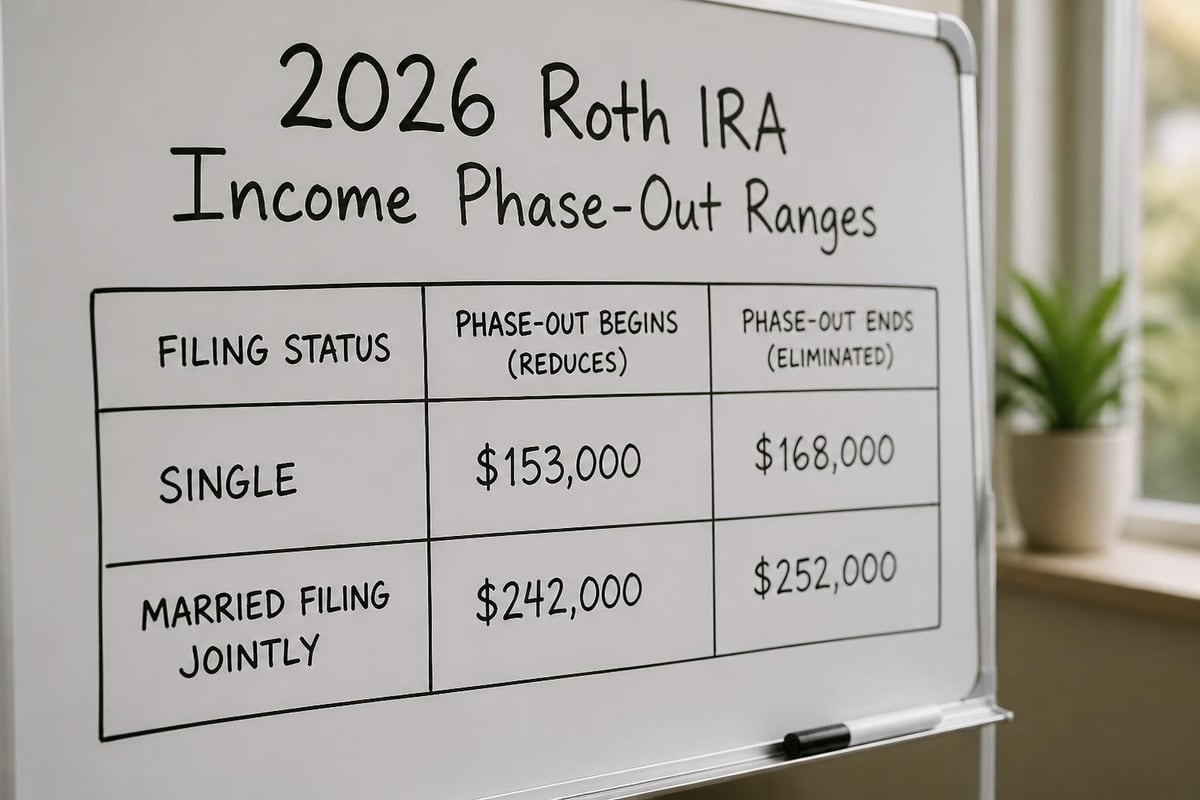
Your self employed Roth IRA follows the same contribution and eligibility rules as any other Roth IRA. Modified adjusted gross income determines whether you can contribute. For 2026, the phase-out begins at $146,000 for single filers and $230,000 for married filing jointly.
Above those thresholds, your allowed contribution shrinks. At $161,000 single or $240,000 married, you're locked out entirely.
The money goes in after-tax. It grows tax-free. Qualified distributions after age 59½ come out tax-free. You've heard this before.
What you may not have considered: the self employed Roth IRA is just one tool in a much larger toolkit. Alone, it caps at $7,000 or $8,000. Combined with other self-employed retirement structures, you can push annual tax-advantaged contributions well into six figures.
Solo 401(k) Plans Open the Real Capacity
Most self-employed business owners who stop at a simple Roth IRA miss the one-participant 401(k). The IRS calls it a one-participant plan. Most people call it a Solo 401(k). Either way, it's available to any business owner with no employees other than a spouse.
Here's where the numbers shift.
Employee deferrals: You can contribute up to $23,000 as an employee in 2026 ($30,500 if you're 50 or older). That's separate from your Roth IRA.
Employer contributions: Your business can add up to 25% of your W-2 compensation (if you're an S-corp) or 20% of your net self-employment income (if you're a sole proprietor or single-member LLC). Total combined limit: $69,000 in 2026 ($76,500 with catch-up).
Many Solo 401(k) providers now offer a Roth elective deferral option within the plan. That means you can direct some or all of your $23,000 employee deferral into a Roth bucket inside your 401(k). The employer profit-sharing piece stays traditional (pre-tax), but the employee side can go Roth.
Why This Matters More Than a Standalone Self Employed Roth IRA
You're not choosing between a self employed Roth IRA and a Solo 401(k). You can fund both in the same year, as long as your total employee deferrals across all 401(k) plans don't exceed $23,000 ($30,500 with catch-up).
So the typical strategy:
- Max your Solo 401(k) Roth elective deferral: $23,000
- Add employer profit-sharing (traditional): as much as the 25%/20% formula allows
- Separately fund a self employed Roth IRA: $7,000
Total Roth contributions in one year: $30,000. Total tax-advantaged savings: potentially north of $60,000 depending on your income.
That's not a typo. It's just coordination.
SEP IRAs and SIMPLE IRAs Don't Offer Roth Treatment
You'll see plenty of comparisons between SEP IRAs, SIMPLE IRAs, and Solo 401(k)s. The short version: SEP and SIMPLE plans do not allow Roth contributions under current law.
SEP IRA: Contributions go in pre-tax. You can contribute up to 25% of W-2 compensation or 20% of net self-employment income, capped at $69,000 in 2026. No Roth option. No employee deferrals. Just employer contributions.
SIMPLE IRA: Available if you have fewer than 100 employees. You can defer up to $16,000 as an employee in 2026 ($19,500 with catch-up), and your business matches. All contributions are traditional. No Roth bucket exists.
If you want Roth treatment as a self-employed person, your menu is limited to:
- A standalone self employed Roth IRA
- A Solo 401(k) with Roth elective deferrals
- Backdoor Roth conversions (discussed next)
The Backdoor Roth Strategy for High Earners
If your income exceeds the Roth IRA phase-out limits, direct contributions to a self employed Roth IRA are off the table. The backdoor Roth maneuver solves that.
Here's the mechanic:
- Contribute to a traditional IRA (nondeductible, since your income likely phases out the deduction as well).
- Immediately convert that traditional IRA to a Roth IRA.
- Pay tax on any earnings between contribution and conversion (usually zero if you convert quickly).
No income limit applies to Roth conversions. You can execute this every year.
The Pro-Rata Rule Complication
If you have any pre-tax IRA balances – traditional IRA, SEP IRA, SIMPLE IRA – the IRS applies the pro-rata rule. Your conversion isn't purely from nondeductible contributions. Instead, the IRS looks at your total IRA balance and calculates the taxable portion based on the ratio of pre-tax to after-tax dollars.
Example:
- You contribute $7,000 nondeductible to a traditional IRA.
- You already have $63,000 in a rollover traditional IRA from an old 401(k).
- Total IRA balance: $70,000. Your nondeductible basis: $7,000 (10%).
- When you convert $7,000 to Roth, only 10% ($700) is tax-free. The other $6,300 is taxable income.
That wipes out most of the backdoor benefit.
The workaround: roll your existing pre-tax IRA balances into your Solo 401(k) before executing the backdoor conversion. Most Solo 401(k) plans accept incoming rollovers. Once those pre-tax dollars sit in your 401(k), they're no longer "IRA" dollars for pro-rata purposes. Your backdoor conversion becomes clean.
This is planning. Not just filing.

Contribution Deadlines and Timing Nuances
Your self employed Roth IRA contribution deadline is your tax filing deadline, including extensions. For most people, that's April 15, 2027 for the 2026 tax year (or October 15, 2027 if you file an extension).
Solo 401(k) employee deferrals must be made by December 31 of the tax year. You can't extend that. If you want to count a $23,000 Roth elective deferral for 2026, the money has to move by December 31, 2026.
Solo 401(k) employer profit-sharing contributions follow the same deadline as your tax return – April 15 or your extended deadline.
| Contribution Type | Deadline | Can Be Extended? |
|---|---|---|
| Roth IRA | Tax filing deadline | Yes (with extension) |
| Solo 401(k) employee deferral | December 31 | No |
| Solo 401(k) employer contribution | Tax filing deadline | Yes (with extension) |
| SEP IRA | Tax filing deadline | Yes (with extension) |
Miss the December 31 cutoff for employee deferrals, and you lose that capacity for the year. No do-overs.
Roth Conversions as a Long-Term Strategy
Beyond annual contributions, self-employed business owners often have existing traditional retirement balances – old 401(k)s, SEP IRAs, rollover IRAs. Converting some or all of that money to Roth creates a tax bill today in exchange for tax-free growth and distributions later.
When does this make sense?
Low-income years. Your business has a down year. You're in the 12% or 22% bracket instead of your usual 32% or 35%. Convert enough traditional IRA or 401(k) money to fill up the lower bracket. Pay tax at 22% now, avoid 35% later.
Before required minimum distributions. Roth IRAs have no lifetime RMDs. Traditional IRAs and 401(k)s force you to start taking taxable distributions at age 73 (as of 2026). If you don't need the cash and you want to leave tax-free wealth to heirs, converting to Roth before RMDs begin makes sense.
When you expect higher rates. If you believe your tax rate in retirement will equal or exceed your current rate, Roth wins. Self-employed income is volatile. A Roth bucket smooths the tax outcome.
The self employed Roth IRA and Solo 401(k) Roth contributions are new money going in. Roth conversions are repositioning old money. Both are part of the same tax planning chess game.
Mega Backdoor Roth (If Your Plan Allows It)
Some Solo 401(k) plans allow after-tax contributions beyond the $23,000 employee deferral limit, up to the total $69,000 cap. You make those contributions after-tax, then immediately convert them to Roth within the plan (an in-plan Roth conversion) or roll them to a Roth IRA.
This is the mega backdoor Roth.
Example:
- You're 45, self-employed, S-corp owner with $200,000 W-2.
- Employee deferral (Roth): $23,000
- Employer profit-sharing (25% of W-2): $50,000
- Total so far: $73,000… but the limit is $69,000, so employer contribution drops to $46,000.
- If your plan document permits after-tax contributions, you could contribute an additional $23,000 after-tax ($69,000 total minus $23,000 employee deferral minus $46,000 employer = $0 room… no, wait: employer is capped separately).
Actually, the math here requires your plan to be designed correctly. Not all Solo 401(k) providers support after-tax contributions or in-plan Roth conversions. You need to ask specifically. Fidelity, E*TRADE, and some others allow it. Many cookie-cutter plans do not.
If your plan supports it, the mega backdoor Roth lets you push tens of thousands of additional dollars into Roth buckets every year. If it doesn't, you're limited to the $23,000 Roth elective deferral plus your standalone self employed Roth IRA.
Check your plan document. This isn't automatic.
Interaction Between IRAs and 401(k)s in Your Overall Portfolio
The systemic research on how IRAs and 401(k)s interact shows that most savers treat them as separate buckets. But optimal planning views them as a single coordinated portfolio.
Asset location matters. Bonds and REITs throw off ordinary income. Better in Roth, where that income never gets taxed. Growth stocks generate long-term capital gains, which are already tax-advantaged. Fine in taxable accounts.
If you're splitting contributions between a traditional Solo 401(k) employer contribution and Roth elective deferrals plus a self employed Roth IRA, think about where each dollar is most tax-efficient over 20 or 30 years.
- High-growth, high-turnover investments: Roth
- Dividend-paying stocks, bonds, inflation-protected securities: traditional or Roth, depending on your current vs. future rate
- Broad index funds: either bucket works; tilt based on tax rate arbitrage
Most people randomize this. Planning means you don't.

What Happens When You Hire Employees
The moment you hire a W-2 employee who isn't your spouse, your Solo 401(k) ends. The plan was designed for owner-only businesses. Once you have employees, you need a different structure – typically a standard 401(k) with employee eligibility rules, nondiscrimination testing, and higher administrative costs.
Your self employed Roth IRA stays intact. That's individual. Doesn't matter how many people you employ.
But your ability to make $46,000 or $50,000 employer profit-sharing contributions without covering employees? Gone. You'll either switch to a SEP IRA (where you contribute the same percentage for everyone) or set up a real 401(k) with safe harbor provisions.
Plan the transition before you hire. Don't let a great retirement vehicle disappear because you didn't structure the hire correctly. Sometimes it's worth keeping contractors instead of employees. Sometimes it's worth setting up a separate entity. Depends on the numbers.
State Tax Considerations for Roth Contributions
Federal law governs whether your self employed Roth IRA or Solo 401(k) Roth contributions are taxable. Most states follow federal treatment – Roth contributions are after-tax, growth is tax-free, qualified distributions are tax-free.
A few states don't have income tax at all (Florida, Texas, Nevada, Washington, South Dakota, Alaska, Wyoming, Tennessee). Roth vs. traditional doesn't matter on the state side if there's no state tax.
A handful of states tax Roth conversions or have quirks around retirement account treatment (Pennsylvania taxes retirement distributions differently, California has unique rules for nonresidents). If you're in one of those states, the Roth decision shifts slightly.
For most U.S. business owners, state tax mirrors federal. The Roth vs. traditional question hinges on your federal marginal rate today vs. your expected federal rate in retirement.
When a Self Employed Roth IRA Alone Isn't Enough
If your business generates $150,000 in net income and you're only contributing $7,000 to a self employed Roth IRA, you're missing the bigger picture. That's less than 5% of your income going to tax-advantaged retirement savings.
Compare that to an employee with a 401(k) who defers $23,000 and gets a $10,000 employer match. They're saving $33,000 on $150,000 – 22%.
You have access to the same or better capacity. You just have to set it up.
The career-change and self-employment guidance from CFP Board makes this point clearly: switching from W-2 employment to self-employment doesn't mean you lose retirement planning capacity. You gain control. But only if you use it.
A standalone self employed Roth IRA is a start. It's not the finish line.
Common Mistakes That Cost You
Waiting until April to fund last year's contribution. The money could've been growing for 15 months. Front-load contributions in January if cash flow allows.
Ignoring the December 31 deadline for Solo 401(k) deferrals. Employee contributions can't be extended. Mark the calendar. Make the transfer before year-end.
Failing to update your Solo 401(k) when you get married or hire someone. Plan rules change. Eligibility changes. You can't just ignore it and hope the custodian fixes it.
Not coordinating Roth conversions with income timing. If you're converting $50,000 from a traditional IRA to Roth the same year you sell your business and recognize a $300,000 gain, you just paid tax at the top bracket on money that could've converted in a lower-income year.
Assuming your CPA is handling this. Most CPAs prepare returns. They report what happened. They don't proactively build multi-year Roth strategies or tell you to open a Solo 401(k) in November. That's planning, not compliance.
How Business Structure Affects Your Contribution Calculation
Your self employed Roth IRA contribution doesn't change based on entity type. But your Solo 401(k) employer contribution does.
| Entity Type | Employer Contribution Calculation |
|---|---|
| Sole proprietor (Schedule C) | 20% of net self-employment income (after deducting ½ SE tax) |
| Single-member LLC (default) | Same as sole proprietor – 20% of net income |
| S-corp | 25% of W-2 wages you pay yourself |
| Partnership | 20% of net earnings (gets complex with guaranteed payments) |
If you're an S-corp paying yourself $100,000 W-2, your employer contribution caps at $25,000. If you're a sole proprietor with $100,000 net Schedule C income, the calculation is roughly $18,587 after the self-employment tax adjustment.
The math matters. S-corps often allow higher contribution capacity, but they come with payroll tax compliance and reasonable compensation rules. Structure follows strategy, not the other way around.
Should You Split Between Traditional and Roth?
You don't have to go all-in on Roth. Many self-employed business owners split:
- Roth for employee deferrals (the $23,000 you control)
- Traditional for employer contributions (the profit-sharing piece)
This gives you tax diversification. Some money comes out tax-free in retirement. Some money is taxable but gave you a deduction today.
In volatile income years, that diversification helps. High-income year? Take traditional deductions to soften the tax hit. Low-income year? Pull from Roth and pay zero tax.
A pure Roth strategy works if you're certain your retirement tax rate will exceed today's rate. A pure traditional strategy works if you expect lower rates later. Splitting covers the middle ground when you're not sure.
Most business owners aren't sure. Income swings. Tax law changes. Splitting is the hedge.
The self employed Roth IRA is a floor, not a ceiling. Stack it with a Solo 401(k), coordinate conversions, and watch the deadline calendar. That's how you build tax-free wealth while running a business.
Taxt builds retirement and tax strategies for U.S. business owners who want more than compliance – our five-step process shows you where the real capacity sits and how to use it year after year.