IRS problems aren't as complicated as they look once you see the structure. I'm attorney Darrin Mish. I've represented taxpayers before the IRS for three decades — in Florida, Colorado, Texas, and internationally. Here's the plain-English breakdown.
I'm Darrin Mish. Tampa tax attorney, 32 years in, more than $100 million in IRS debt resolved. That's my resolution practice. What follows is the other side of the desk – the planning moves that keep you from ever needing it.
Your CPA probably asks which IRA you want without explaining why it matters. The choice between a traditional roth ira strategy isn't just about checking boxes on a retirement form. It's about reverse-engineering your tax liability across decades.
Most business owners think about retirement accounts when their accountant mentions them in March. That's 11 months too late. The real planning happens when you map your income trajectory against the tax code and build a withdrawal strategy before you make your first contribution.
Understanding the Traditional Roth IRA Decision
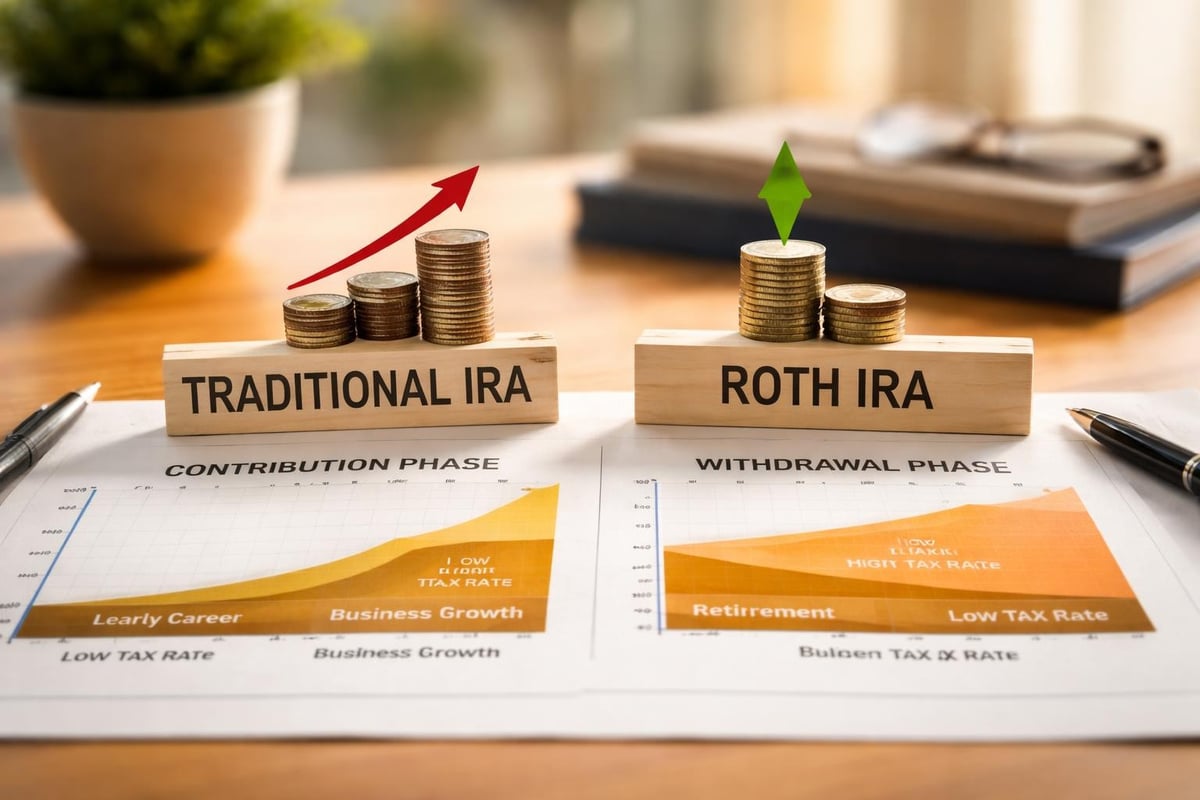
You're not choosing between two retirement accounts. You're choosing when to pay taxes on the same money.
A traditional IRA gives you a tax deduction now. You contribute pre-tax dollars, watch them grow tax-deferred, then pay ordinary income tax on every dollar you withdraw in retirement. The IRS treats traditional and Roth IRAs differently because the tax timing fundamentally changes your planning opportunities.
A Roth IRA flips the equation. You contribute after-tax dollars, get no deduction now, but every qualified withdrawal in retirement is completely tax-free. The growth is tax-free. The principal is tax-free. If you do it right, you never pay another dollar of tax on that money.
The traditional roth ira question isn't which account is "better." It's which tax rate you want to lock in.
The Tax Bracket Arbitrage Most Advisors Miss
Here's what your financial advisor isn't telling you: this decision is pure tax arbitrage.
If you're in a high tax bracket now and expect to be in a lower bracket in retirement, the traditional IRA wins. You deduct at 35% and withdraw at 22%. That's a 13-percentage-point spread working in your favor.
If you're building a business and your income is climbing, the Roth makes sense. You pay tax at 24% now and withdraw tax-free when you're in the 35% bracket. The math flips in your favor.
The problem: most business owners have no idea what their future tax bracket will be. They're guessing. That's not planning, that's hoping.
Contribution Limits and Income Restrictions You're Working Around
The traditional roth ira landscape changed for 2026, and the numbers matter.
For 2026, you can contribute up to $7,000 to either a traditional or Roth IRA if you're under 50. If you're 50 or older, you get an additional $1,000 catch-up contribution, bringing your total to $8,000. Contribution limits apply across both account types, so you can't double-dip.
The income restrictions are where it gets interesting:
| Filing Status | 2026 Roth IRA Phase-Out Range | Full Contribution Allowed Below |
|---|---|---|
| Single | $150,000 – $165,000 | $150,000 |
| Married Filing Jointly | $236,000 – $246,000 | $236,000 |
| Married Filing Separately | $0 – $10,000 | $0 |
Traditional IRAs have no income limits for contributions. Anyone with earned income can contribute. The deduction gets phased out if you're covered by a retirement plan at work, but you can always contribute.
The Backdoor Strategy Business Owners Actually Use
High-income business owners can't contribute directly to a Roth IRA. The phase-out ranges block them. So they use the backdoor.
You make a non-deductible contribution to a traditional IRA. Then you immediately convert it to a Roth IRA. Since the contribution wasn't deductible, there's no tax on the conversion. You've just funded a Roth despite the income limits.
This works cleanly if you have no other traditional IRA balances. If you do, the pro-rata rule kicks in and you'll owe tax on part of the conversion. That's where most people mess it up. They forget about the old rollover IRA sitting at Fidelity and create a tax bill they weren't expecting.
The planning move: if you're using the backdoor, clear out your traditional IRA balances first. Roll them into your 401(k) if your plan allows. Then the backdoor conversion is clean.
Required Minimum Distributions and the Roth Advantage
Traditional IRAs force you to start withdrawing money at age 73 under current law. These required minimum distributions (RMDs) happen whether you need the money or not. The IRS wants its tax revenue.
Roth IRAs have no RMDs during your lifetime. The money sits there, growing tax-free, for as long as you want. You can pass it to your heirs with the tax-free growth still intact, subject to the 10-year distribution rule for most non-spouse beneficiaries.
This is where the traditional roth ira planning gets sophisticated. If you don't need retirement distributions to live on, the Roth preserves more wealth. You're not paying tax on money you don't need. You're not being forced to take distributions that push you into higher tax brackets.

How RMDs Destroy Other Planning Opportunities
RMDs from traditional IRAs create tax problems that cascade into other areas:
- They increase your Medicare Part B and Part D premiums through IRMAA surcharges
- They trigger taxation of your Social Security benefits
- They push you into higher capital gains brackets
- They can disqualify you from certain tax credits and deductions
A Roth IRA avoids all of this. No forced distributions means you control your taxable income in retirement. That control is worth real money when you're planning around Medicare, Social Security, and other income-tested programs.
Conversion Strategies Your CPA Isn't Modeling
The traditional roth ira decision isn't permanent. You can convert traditional IRA money to a Roth at any time. You'll pay tax on the converted amount, but then it's Roth money forever.
Smart conversions happen in low-income years. Business had a bad year? Perfect time to convert. Taking a sabbatical? Convert. Retired early and living on savings before Social Security kicks in? Convert everything you can at the 12% or 22% brackets.
The planning question is: how much should you convert and when?
The framework: convert enough to fill up your current tax bracket, but not so much that you spill into the next one. If you're married filing jointly in 2026, the 24% bracket tops out at $383,900 of taxable income. Convert right up to that line, then stop.
| Married Filing Jointly 2026 | Tax Rate | Taxable Income Range |
|---|---|---|
| 10% | $0 – $23,200 | Convert aggressively |
| 12% | $23,201 – $94,300 | Strong conversion zone |
| 22% | $94,301 – $201,050 | Good conversion zone |
| 24% | $201,051 – $383,900 | Evaluate carefully |
| 32% | $383,901 – $487,450 | Usually not ideal |
Understanding these contribution limits and income restrictions helps you time conversions correctly.
The Multi-Year Conversion Calendar
You don't convert everything in one year unless you enjoy writing big checks to the IRS. You spread conversions across multiple years to manage your effective tax rate.
Year one: convert $50,000 at 22%. Year two: another $50,000 at 22%. Year three: same thing. Over three years, you've moved $150,000 to tax-free Roth status at a controlled tax cost. Compare that to taking $150,000 as traditional IRA distributions in retirement when you might be at 32% or higher.
The math works even better if you have down years in your business. A year with $100,000 of income instead of your usual $300,000 creates conversion opportunities most business owners miss completely. Strategic Roth IRA planning captures these windows.
Business Owner Scenarios That Change the Calculation
Your business structure changes how you think about the traditional roth ira question.
S-corp owners: you're taking a salary plus distributions. Your salary counts as earned income for IRA contributions. Your distributions don't. If you're minimizing salary for payroll tax purposes (which you should be), make sure you have enough W-2 income to support your desired IRA contribution.
LLC owners: your self-employment income counts as earned income. All of it. You can max out your IRA contributions as long as your net self-employment income exceeds your contribution amount.
Multi-business owners: your earned income from all businesses combines for IRA contribution purposes. One business losing money doesn't prevent you from contributing based on income from another business.
The Retirement Plan Coordination Most People Botch
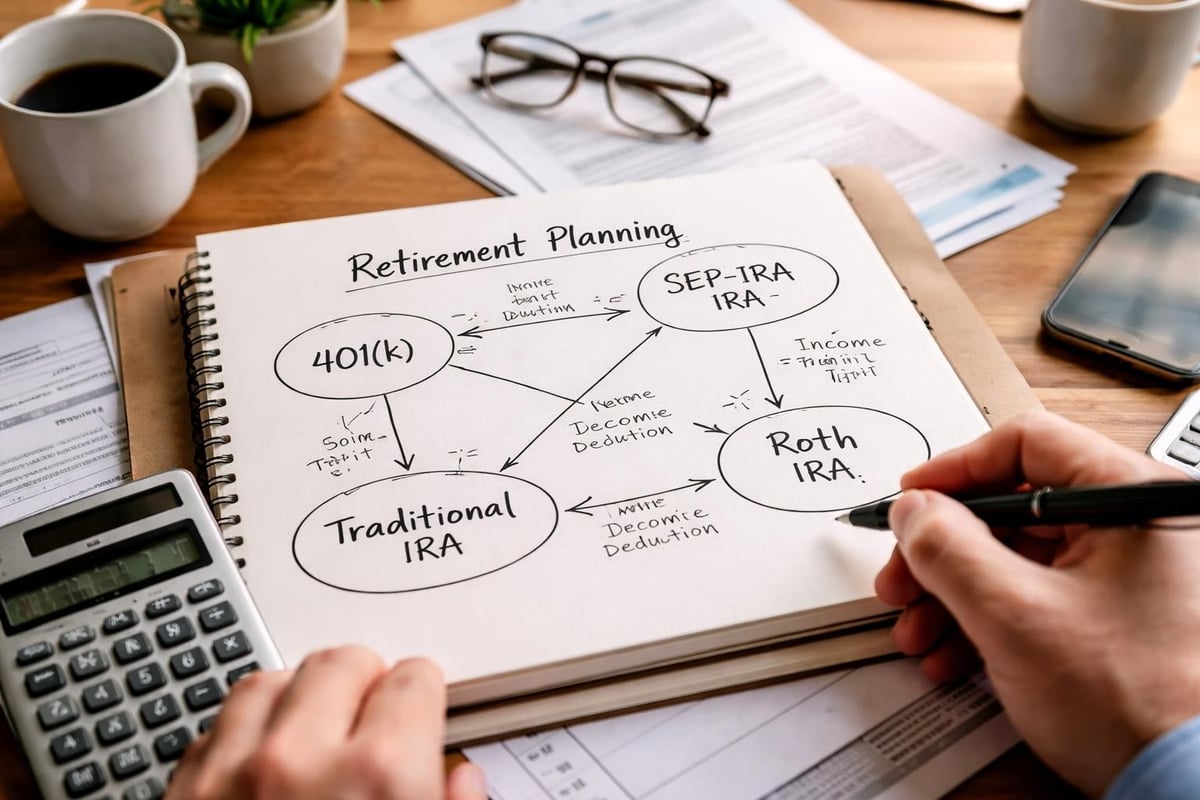
If you have a 401(k) or SEP-IRA through your business, your traditional IRA deduction might be limited. The IRS phases out the deduction based on your income if you're covered by an employer plan.
For 2026, if you're married filing jointly and covered by a workplace retirement plan, the traditional IRA deduction phases out between $123,000 and $143,000 of modified adjusted gross income. That's lower than most successful business owners earn.
But here's the planning opportunity: your spouse might not be covered by a retirement plan. If they have earned income and aren't covered by a workplace plan, they can deduct traditional IRA contributions up to much higher income levels ($236,000 to $246,000 for 2026).
This creates a strategy: max out the Roth for the high-earning spouse who can't deduct a traditional IRA anyway. Max out the traditional IRA for the lower-earning spouse who can still get the deduction. You're splitting the difference on the traditional roth ira decision based on each person's individual tax situation.
State Tax Considerations That Shift the Math
Federal taxes aren't the whole story. Your state's tax treatment of retirement accounts can flip the traditional roth ira decision completely.
Some states don't tax retirement income at all. If you're planning to retire in Florida, Texas, Nevada, or another no-income-tax state, the traditional IRA deduction is worth more. You deduct at your combined federal and state rate now, then withdraw at your federal-only rate later.
Other states offer special deductions or exclusions for retirement income that can make traditional IRAs more attractive than the pure federal math suggests.
The planning mistake: assuming you'll retire in the same state where you're working now. If there's any chance you'll move to a lower-tax or no-tax state in retirement, that shifts the equation toward traditional IRA contributions now.
The Five-Year Rules Nobody Explains Correctly
Roth IRAs have two different five-year rules, and confusing them costs people money.
Rule one: you must wait five years from your first Roth contribution before earnings can be withdrawn tax-free. This applies even if you're over 59½. First contribution in 2026? Earnings aren't qualified until 2031.
Rule two: each Roth conversion has its own five-year waiting period before you can withdraw the converted amount penalty-free if you're under 59½. This doesn't apply to earnings or to people over 59½.
Most business owners only hear about one of these rules and assume it covers everything. It doesn't. The mechanics of Roth IRA withdrawals matter when you're planning distribution strategies.
The Ordering Rules That Protect Your Principal
Roth IRA withdrawals come out in a specific order that generally works in your favor:
- Regular contributions (always tax-free and penalty-free)
- Conversion principal (tax-free, potentially subject to 10% penalty if under 59½ and within five years)
- Earnings (tax-free and penalty-free only if qualified)
This means you can always access your original contributions without tax or penalty. That makes Roth IRAs more flexible than traditional IRAs for emergency access, though that's not their primary purpose.
Coordinating IRAs with Your Business Retirement Plan
You're probably running a Solo 401(k), SEP-IRA, or SIMPLE IRA through your business. These plans have much higher contribution limits than IRAs. For 2026, a Solo 401(k) lets you defer up to $23,500 as an employee ($31,000 if you're 50 or older), plus employer profit-sharing contributions up to 25% of compensation.
So why bother with the traditional roth ira question at all?
Answer one: spousal IRAs. Your spouse might not have earned income from your business. An IRA provides retirement savings for them.
Answer two: Roth options. Not all business retirement plans offer Roth contributions. If you want tax-free growth, a Roth IRA might be your only option.
Answer three: flexibility. IRAs have simpler rules, more investment options, and easier access than most business retirement plans.
The sophisticated strategy: max out your business retirement plan for the immediate tax deduction and tax-deferred growth. Then layer Roth IRA contributions (or backdoor Roth conversions) on top for tax-free diversification. You're building a tax-diversified retirement portfolio where you can control which accounts you tap in retirement based on your tax situation at the time.
Estate Planning Implications Most Advisors Ignore
Traditional IRAs are terrible assets to inherit if you're in a high tax bracket. Your beneficiaries inherit your tax liability. They get no step-up in basis. Every dollar they withdraw is ordinary income taxed at their rate.
Roth IRAs are the opposite. Your heirs inherit tax-free money. They must withdraw it within 10 years under current law (unless they're a spouse or other eligible designated beneficiary), but those withdrawals are completely tax-free.
If you're thinking about wealth transfer, the traditional roth ira decision is really asking: do you want to pay the tax, or do you want your kids to pay it?
The planning answer: you probably want to pay it. You're likely in a lower bracket now than your high-earning kids will be when they inherit. Pay tax at 24% or 32% now through Roth conversions rather than leaving them with a tax bill at 35% or 37% later.
The Qualified Charitable Distribution Strategy
Here's a planning move that makes traditional IRAs valuable in specific situations: qualified charitable distributions (QCDs).
If you're over 70½, you can transfer up to $105,000 per year (indexed for inflation, $108,000 for 2026) directly from your traditional IRA to a qualified charity. The distribution counts toward your RMD but isn't included in your taxable income.
You can't do this with a Roth IRA. The tax benefit doesn't work because Roth distributions are already tax-free.
If you're charitably inclined and expect to make significant donations in retirement, keeping some money in a traditional IRA creates a planning opportunity. You're essentially converting what would have been a charitable deduction (which you might not benefit from if you take the standard deduction) into an above-the-line exclusion from income.
How Business Income Volatility Changes Your Strategy
Your business doesn't generate the same income every year. Most business owners see significant variation. That volatility creates traditional roth ira planning opportunities that W-2 employees don't have.
In high-income years, you want every possible deduction. Traditional IRA contributions make sense if you're eligible for the deduction. You're pulling income out of the highest brackets.
In low-income years, you want to accelerate income recognition while you're in low brackets. Roth conversions make sense. You're recognizing traditional IRA or pre-tax retirement plan income at artificially low rates.
The annual planning question: what does your income look like this year compared to your average? If it's unusually high, go traditional. If it's unusually low, go Roth or convert.
Most business owners don't revisit this question annually. They set up automatic IRA contributions and forget about them. That's leaving money on the table. Your optimal strategy shifts every year based on your actual tax situation.
When the Traditional Roth IRA Decision Doesn't Matter
Sometimes the math is so close that the decision doesn't materially affect your long-term outcome.
If you expect to be in roughly the same tax bracket in retirement as you are now, the traditional and Roth IRA produce nearly identical after-tax results. You're paying the same tax rate either way, just at different times.
If your income is close to the Roth contribution phase-out ranges, the decision might be made for you. You either qualify or you don't.
If you're only contributing small amounts (say, $2,000 a year), the long-term difference between traditional and Roth is small enough that other factors (simplicity, estate planning, Medicare coordination) should drive your decision instead of pure tax math.
The planning reality: for most business owners with substantial income and long time horizons, the traditional roth ira decision is worth modeling carefully. But for others, picking either option and contributing consistently matters more than optimizing between the two.
The traditional roth ira decision requires actual tax modeling, not generic advice from someone who doesn't understand your business income pattern or your exit strategy. Taxt builds multi-year projections that show exactly what your retirement accounts will be worth after-tax, accounting for RMDs, Social Security coordination, and Medicare surcharges, then designs contribution and conversion strategies that maximize what you keep.